Programmatic Advertising: Why Do Resellers Generate Over 80% of Bid Requests?
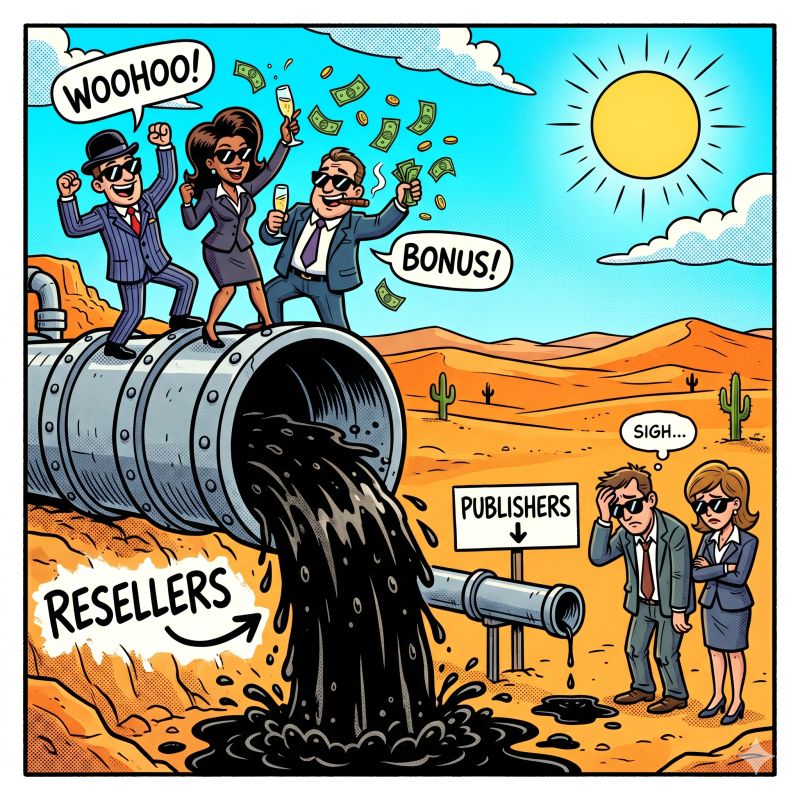
More than 80% of bid requests observed across two major programmatic exchanges came from reseller SSP seats, rather than seats operated directly by publishers. Yes, really. 😱 But before blaming every reseller in sight, we need to ask a better question: which supply paths actually create value?
In the GreyFox Ads analysis cited in the original post, publisher-direct SSP seats accounted for 17% of bid requests across two major exchanges, excluding Google Ad Manager (GAM). The remaining share was associated with other supply paths, including resellers. This is a limited observation, not a market-wide census. Supply Path Optimisation (SPO) can help buyers and publishers distinguish valuable intermediaries from avoidable duplication.
Only 17% of bid requests from direct publisher seats?
That's the finding that caught my attention. In a study conducted across two major exchanges, excluding GAM, SSP seats owned directly by publishers represented just 17% of the observed bid-request volume. That leaves more than 80% flowing through other seats or routes in this dataset.
One important distinction: a bid request is an auction opportunity sent to potential buyers, not a unique user, impression sold, or euro spent. A single impression opportunity can generate multiple requests along different routes. The underlying exchange names, sampling period and methodology were not included in the original post, so this figure should not be generalised to the entire French or global Open Web.
Not all resellers are villains. Some are genuinely useful.
Let's be fair. Some resellers bring real incremental value to publishers and advertisers. For example:
- Exclusive formats: enriched skins, such as those associated with Sublim (Azerion).
- Technical integrations: access to specific advertising experiences, such as a Dailymotion video player integration.
- Commercial demand: a sales team capable of attracting additional budgets, as illustrated by Teads.
These are examples of the types of value a reseller can provide—not proof that every integration or commercial arrangement delivers incremental revenue in every situation.
When 100 SSP seats look less like innovation and more like a photocopier 🖨️
While auditing ads.txt files from French publisher websites, we found resellers declaring more than 100 SSP seats. The ads.txt standard lets publishers publicly declare authorised sellers of their advertising inventory. But a declared seat is not necessarily active, and the number of entries alone cannot prove how many bid requests are actually generated.
Still, it raises a legitimate question: are these routes bringing new demand, unique technology or better formats—or merely multiplying the same opportunity?
| Potential problem | Why it matters | What needs checking |
|---|---|---|
| Duplicate bid requests | More processing for substantially the same opportunity | Actual request logs and auction-path overlap |
| Throttling and filtering | Some routes may receive fewer opportunities to compete | DSP/SSP rules, win rates and routing data |
| Extra intermediary fees | Less working media may reach the publisher | Net revenue and the full fee chain |
| Opaque resale relationships | Harder to establish who is adding value | Contracts, sellers.json, schain and ads.txt |
My concern is that direct publisher seats can be drowned out by redundant paths, potentially weakening their competitiveness and revenue. But the causal chain—from duplication to throttling to lower publisher earnings—needs transaction-level evidence; it is not automatic. The same applies to the claim that additional intermediaries always reduce advertiser return on investment.
Four SPO moves publishers should consider
Supply Path Optimisation (SPO) means choosing and improving the routes through which ad inventory reaches buyers, with the goal of reducing waste and improving transparency and outcomes. And no, SPO shouldn't be left entirely to DSPs.
- Demand contractual transparency. Ask partners what they sell, through which seats, and what fees and services they add.
- Audit reseller incrementality. Work with a DSP where possible to compare demand and outcomes by route (dedicated pixels or creative IDs per reseller can help in a carefully designed test).
- Explore transaction-level deduplication. The original post advocates a shared Transaction_ID across SSPs to help DSPs recognise repeated opportunities. Its practical availability and standardisation must be verified for each integration.
- Revisit investment-flow transparency initiatives. In France, the original post points to the TrustID project, associated with Union des marques, EdiPub and SRI, as an example of an effort to improve programmatic traceability. Relaunching such work is a proposal, not an announced industry commitment.
What can media traders do about reseller-heavy supply?
Start by identifying direct publisher SSP seats and testing them against alternative routes. Compare delivery, win rate, effective CPM, publisher revenue where available, quality, and total fees—not just the number of intermediaries.
Sounds obvious? Unfortunately, some DSP interfaces don't give traders enough control to select individual publisher seats. 😕 When that happens, buyers can still ask their platform for better supply-path reporting and more granular controls.
Direct does not automatically mean best. A reseller offering exclusive inventory, a meaningful integration or incremental demand may be worth its cost. The objective is useful supply paths, not a dogmatic ban on resale.
GreyFox Ads: less supply-chain noise, more useful media
Here in France, at GreyFox Ads, we believe the quality French Open Web can deliver real efficiency for advertisers. We're the smallest ad network in France—but not the dumbest. 🦊
Our Master Deal approach is designed to offer media traders:
- ⭐ Clean supply, prioritising relevant publisher routes and limiting unnecessary resellers
- ⭐ Smart targeting adapted to the campaign
- ⭐ Simplicity through curated activation
- ⭐ Cost transparency across the chain
Discover our programmatic curation expertise and how we approach supply-path efficiency for campaigns targeting France.
Bottom line: optimise the path, not just the price
The 17% figure should prompt questions, not sweeping conclusions. The real test for every reseller is straightforward: what incremental value do you bring, and can you demonstrate it? Better SPO starts when publishers and buyers both demand an answer.
Methodology and original source
The 17% direct-seat share is taken from the original GreyFox Ads commentary, based on two exchanges excluding GAM. No raw dataset, timeframe or independently verified market-wide methodology was supplied. The ads.txt audit examples are observations reported in that post, not a verified count of active bid streams.
Read the original LinkedIn post. For technical background on ads.txt and sellers.json, see IAB Tech Lab.
Buying programmatic media in France?
Looking for clean French Open Web supply, smarter targeting and transparent curated deals? Let's talk.
Contact GreyFox Ads