Programmatic Advertising: The Three Faces of the Open Web
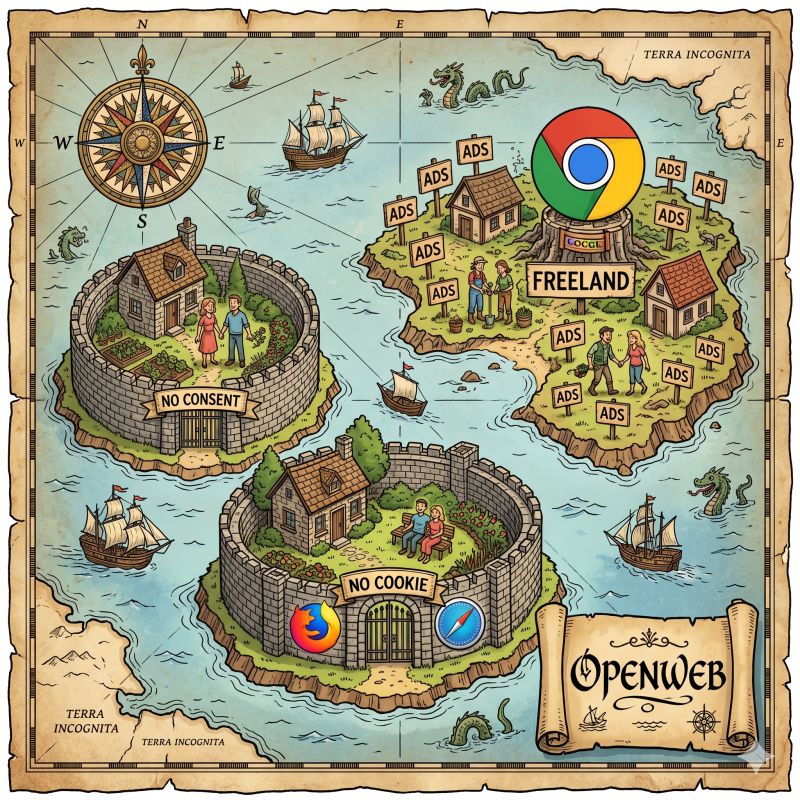
Ten years ago, reaching most internet users through programmatic advertising felt waaayyyyy easier. In 2026? Not so much. Here in France, the Open Web increasingly looks like three different advertising environments—and buying strategies have not always caught up.
GreyFox Ads groups French Open Web sessions into three practical segments: no consent (around 20%), consent granted but third-party cookies unavailable (around 22%), and cookie-enabled sessions (around 58%). These are working estimates from our market analysis, not a published census of all French browsing sessions. Each segment calls for a different approach to targeting.
The three faces of the French Open Web
1. No-consent inventory ❌👌
Under the EU General Data Protection Regulation (GDPR) and applicable ePrivacy rules, consent is generally required for certain advertising identifiers and tracking technologies. That does not mean that every form of advertising or every kind of contextual targeting is prohibited without consent (the legal basis and implementation matter).
In the original analysis, I referred to a 40% refusal rate among users offered a clear “accept all / reject all” choice, citing consent management platform provider Didomi. Treat this as a contextual figure from that analysis rather than a verified, market-wide 2026 rate.
France's data protection authority, the CNIL, has also addressed “consent or pay” models, sometimes called cookie walls. But they are not automatically lawful: the validity of consent and the fairness of the alternative must be assessed case by case.
Our working estimate: around 20% of French sessions fall into this no-consent category.
2. Consent granted, but third-party cookies blocked ✅👌❌🍪
As if consent weren't complicated enough, browsers such as Safari and Firefox have made third-party cookie restrictions a defining privacy feature. A user can consent to advertising purposes while their browser still prevents conventional third-party cookie matching.
Our working estimate: around 22% of sessions sit in this second category. Consent is not the same thing as technical addressability.
3. Cookie-enabled inventory: the “Freeland” ✅👌✅🍪
And then there is the familiar territory: consented sessions where third-party cookie-based activation remains technically possible. In our model, this represents around 58% of French sessions, largely reflecting Chrome's browser footprint at the time of the analysis.
But here comes the twist: our reading of French industry data from Alliance Digitale suggested that this environment captured around 90% of programmatic investment. This is an indicative comparison from the original post, not a like-for-like audited measurement of spend versus sessions (definitions, dates and inventory scope may differ).
42% of sessions outside the usual cookie playbook. Opportunity or illusion?
| Environment | Estimated share of French sessions | Typical targeting options |
|---|---|---|
| No consent | ~20% | Contextual, semantic and appropriately implemented non-personal targeting |
| Consent, no third-party cookies | ~22% | Contextual plus eligible alternative identity solutions |
| Consent and third-party cookies available | ~58% | Cookie-based activation plus other signals |
In other words, around 42% of sessions fall outside the conventional consented third-party-cookie approach. I originally described them as “unused.” More precisely, they are under-addressed by cookie-dependent strategies—not necessarily unsold, unmonetised or unreachable.
And when too many buyers chase the same addressable inventory, greater auction pressure and bid inflation become plausible risks (though proving actual price inflation would require comparable auction data).
So here's the commercial question: why fight everyone else for the same audience when you could build a smarter way to reach the rest?
How should media traders target each of the three environments?
No consent: start with the content, not the person
Think contextual and semantic targeting, content categories, publisher-level signals and other approaches that do not depend on prohibited tracking. Panel-based insights can inform planning at an aggregate level; location signals require their own privacy assessment and cannot simply be assumed lawful without consent.
Consented but cookieless: add eligible alternative IDs
Contextual targeting still works. Where technically supported and legally appropriate, buyers may also evaluate identity solutions such as ID5, First-ID, Utiq, LiveRamp and EUID. Their availability, match rates, consent requirements and DSP compatibility differ—none is a magic universal replacement for cookies.
Cookie-enabled: yes, third-party cookies still have a role
“Why bother? Use third-party cookies like everyone else!” 😏 That was my deliberately provocative line. In practice, even this third segment benefits from good supply-path optimisation, measurement discipline and diversified signals. No one should build a long-term strategy on a single identifier.
How GreyFox Ads approaches the French Open Web
At GreyFox Ads, we're convinced that a high-quality French Open Web can deliver genuine efficiency for advertisers. We're a small independent French programmatic ad network—the smallest in France, perhaps, but not the dumbest. 🦊
Our Master Deal approach aims to give media traders one simpler activation route, combining:
- ⭐ Clean supply and thoughtful supply-path optimisation
- ⭐ Smart targeting adapted to different addressability environments
- ⭐ Simplicity through curated Deal IDs
- ⭐ Cost transparency across the buying chain
Want to explore how curation works? Discover our programmatic curation expertise.
Bottom line: one Open Web, three buying strategies
Cookie-dependent targeting is only one piece of the French Open Web. The opportunity is not to pretend the other sessions are identical—it is to adapt targeting to the consent and technical realities of each environment, then measure incremental reach, outcomes and total costs.
Notes and original source
The 20% / 22% / 58% segmentation, 40% consent-refusal reference and 90% spend comparison reproduce estimates and interpretations from the original GreyFox Ads commentary; their underlying datasets and methodologies are not provided in the source text. They should not be treated as independently verified market statistics. Legal and platform conditions can change.
Read the original LinkedIn post. For official French data-protection guidance, see CNIL.
Buying programmatic media in France?
Looking for quality French Open Web inventory, smarter targeting and transparent curated deals? Let's talk.
Contact GreyFox Ads