Programmatic Advertising: The Open Web Has an Attention Problem
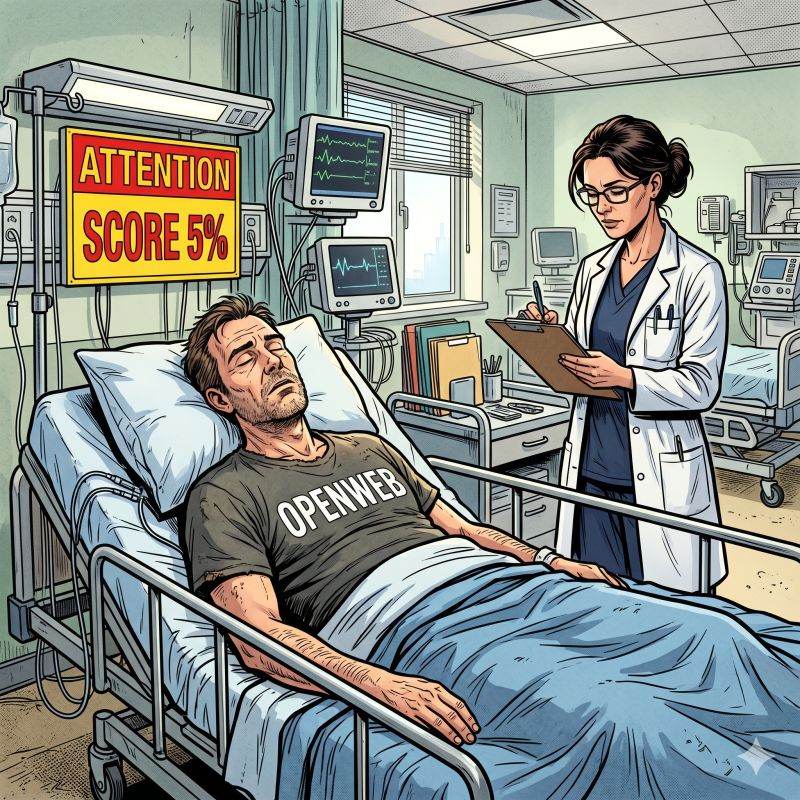
Over 90% of bid requests blocked by attention pre-bid filters in France?! 😱 That's the striking observation behind this article. But the real story isn't that attention measurement is broken. It's that parts of the Open Web advertising experience were designed to meet viewability thresholds, rather than to genuinely earn users' attention.
Attention pre-bid filters can exclude large volumes of inventory when ad placements offer limited screen share, short exposure time or weak video engagement. The over-90% figure comes from the observation in my original post; it is not a published market-wide benchmark, and the outcome depends on the campaign, inventory, vendor and thresholds used.
Why are attention pre-bid filters excluding so much inventory?
First, let's not shoot the messenger. Measurement providers such as xpln.ai and Adelaide are not the villains of this story. When you analyse advertising opportunities at the level of site × placement × device, the combinations that score highly tend to have qualities advertisers can actually use:
- ✅ Large screen share: the ad occupies a meaningful portion of the visible screen.
- ✅ Longer exposure time: users have a real opportunity to notice the message.
- ✅ Audibility for video: sound can contribute to the experience where it is enabled and appropriate.
An attention pre-bid filter uses predictive or observed attention-related signals to decide which impressions a buyer is eligible to bid on, before the auction decision. Different providers use different models and definitions (and a strong attention score is not, on its own, proof of incremental business outcomes).
So if a filter removes most of the available bid requests, that is worth investigating. It does not automatically mean that 90% of all French Open Web impressions are worthless.
The structural problem: optimizing for viewability, not attention
📉 For more than a decade, Open Web publishers have been encouraged to optimize inventory around Media Rating Council (MRC) viewability standards. For standard display ads, the commonly cited baseline is at least 50% of pixels in view for one continuous second; video uses a two-second baseline under the familiar framework.
These standards created a useful common currency. But viewable does not mean noticed, and noticed does not necessarily mean effective. The baseline viewability definitions have remained influential even as formats and user behaviour have evolved.
Some publishers — particularly those employing Made for Advertising (MFA) tactics — have pushed the model to its limits: tiny sticky units, crowded screens and frequent ad refreshes to multiply the number of impressions available for sale. More impressions? Sure. Better advertising? That's another question.
(Not every sticky placement or refresh is inherently an MFA practice; the issue is the overall experience, incentives and measurable quality.)
What can the Open Web learn from Amazon, YouTube and Instagram?
💡 Major platforms do something that sounds almost embarrassingly simple: they adapt advertising to what users came to do.
| User intent | Platform example | Advertising experience |
|---|---|---|
| Find a product | Amazon | Sponsored products integrated into shopping results |
| Watch horizontal video | YouTube | Video advertising designed for the viewing environment |
| Scroll vertical video | Vertical sponsored video in the feed | |
| Read an article | The Open Web | Too often, an assortment of conventional display placements competing for space |
So why shouldn't premium French publishers rethink their own experience around what readers actually want to consume?
Three ideas to help publishers earn more attention
My proposal is deliberately provocative. When someone visits an Open Web publisher to read, why not offer advertising that feels more native to that experience?
- Sponsored articles: clearly labelled, useful branded content designed for a reading context.
- Mobile-first vertical video: a genuinely immersive format, with an option to skip after five seconds.
- Desktop horizontal video: a larger-format experience, again with a five-second skip option.
Would these formats generate more attention than today's tiny, endlessly refreshed ad units? I believe they deserve serious testing. That is a proposal, not a proven universal outcome (and any full-screen format must be tested against user experience, accessibility, consent requirements and publisher engagement).
Publishers should ask themselves two questions: How much attention does my inventory actually generate? And how can I redesign the advertising experience to deliver more value to advertisers?
GreyFox Ads: a French curator focused on quality, not impression volume
Here in France, we believe a high-quality French Open Web can deliver real efficiency for advertisers. At GreyFox Ads, we're the smallest ad network in France — but not the dumbest. 🦊
Our Master Deals aim to make life easier for media traders activating French display and video campaigns through four commitments:
- ⭐ Clean supply — inventory quality and a more deliberate supply path.
- ⭐ Smart targeting — useful signals, not needless complexity.
- ⭐ Simplicity — curated activation rather than an explosion of deals.
- ⭐ Cost transparency — understand where your media budget goes.
Want to go deeper into the mechanics? Explore our programmatic curation expertise.
Bottom line: the Open Web needs to rethink the ad experience
Attention measurement isn't the enemy. It's a wake-up call. If publishers want advertisers to value the Open Web, they need to build ad experiences worth paying attention to — not merely impressions that pass a minimum viewability test.
Editorial source: original LinkedIn post. The 90% figure is a context-specific observation from that post, not an independently verified estimate of the French market.
Looking for a quality programmatic partner in France?
Planning display or video campaigns targeting French audiences? Let's talk about curated supply, attention and media efficiency.
Contact GreyFox Ads