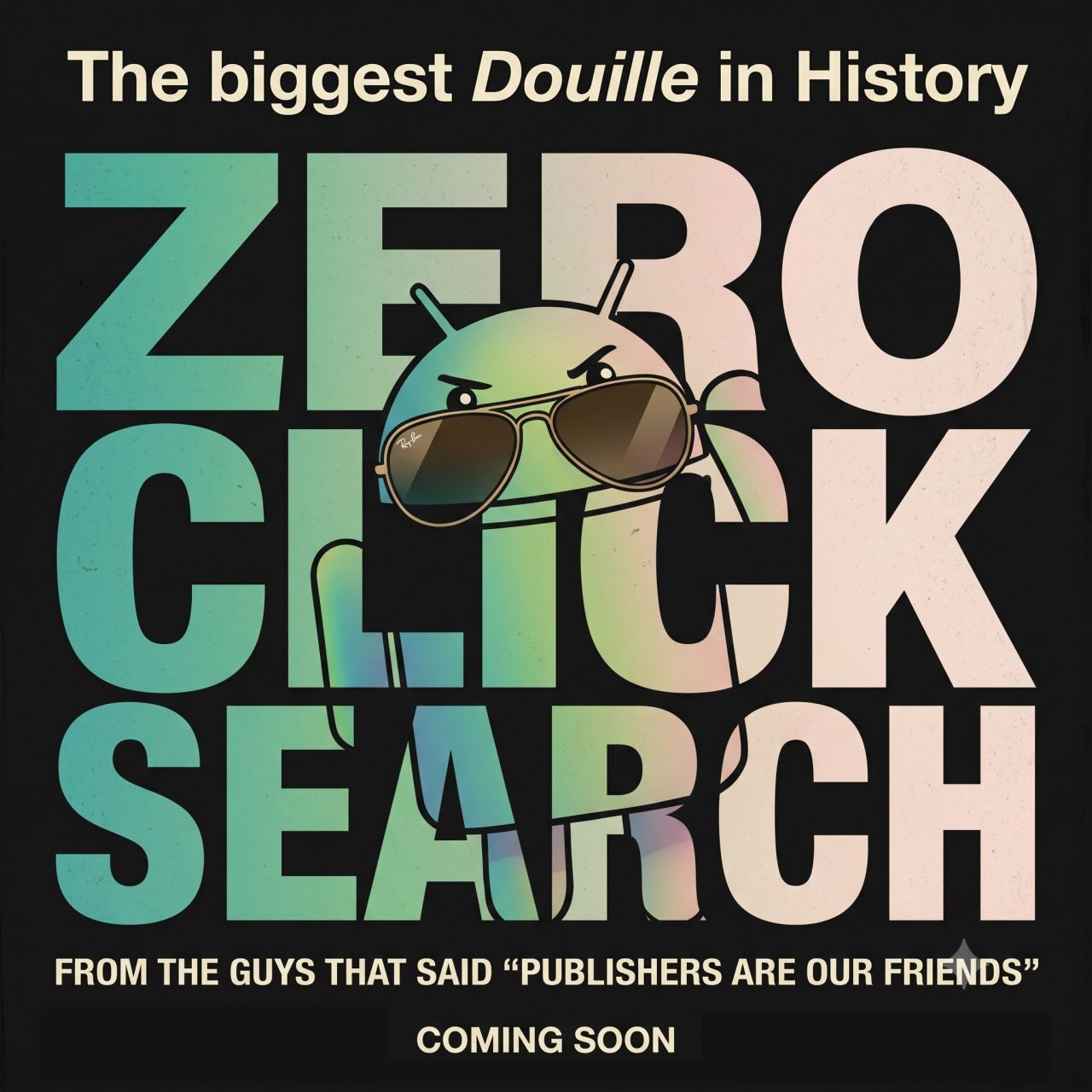
What does zero-click search actually mean? 0️⃣🖱️
A quick definition: Zero Click Search (0-CS) refers to searches made on a search engine where users get their answer directly on the results page — without needing to visit the source website.
Think of checking tomorrow's weather, converting a currency or looking up a definition. The answer appears immediately. Job done. No click required.
It's a double-edged sword:
- 👌 Users save time, and the search engine improves the usefulness of its service.
- 😡 Sources risk losing traffic, because there's no longer any need to click through to read the answer.
A small but important distinction: statistically, a “zero-click” search can also include people who reformulate a query, stay inside the search platform or simply stop searching. Not every zero-click session proves a publisher lost a visit it would otherwise have received.
Did zero-click search exist before ChatGPT?
Oh yes. We've been talking about 0-CS a lot in recent months, but the phenomenon is actually quite old. Let's travel back in time. 🕰️
| Era | Feature | What changed? |
|---|---|---|
| 2002–2005 | 🏃 Instant answers | Google progressively displayed answers such as calculator results, currency conversions, weather, flight information and dictionary definitions directly in Search. |
| 2007* | 📍 Local Pack | Business listings, maps and useful local information became visible within searches, reducing the need to open a separate directory. |
| 2012 | 🧠 Knowledge Graph / Knowledge Panel | Structured information about entities — public figures, places, companies and works — appeared in a single overview, drawing on sources including Wikipedia. |
| 2014* | ✂️ Featured snippets | Google highlighted an extract, list or table from an indexed website above the ordinary organic results. This helped popularise the zero-click debate. |
| 2020s | 🤖 Generative AI answers | AI assistants and AI Overviews can synthesise answers to longer, more complex questions, sometimes linking to the underlying sources. |
*The 2007 and 2014 milestones follow the timeline in my original post and should be understood as approximate markers, not universally agreed launch dates. Google documents its local search offering as early as 2004 and its Knowledge Graph launch in 2012 (Google's Search timeline).
So Zero Click Search has been around for more than 12 years — in fact, the basic idea is even older.
Why, then, are we talking about it so much in 2026? 🤔
Why is zero-click search becoming a much bigger issue with AI in 2026?
Because it's exploded in scale and scope. A traditional instant answer might tell you the weather. A generative AI answer can assemble a detailed explanation from multiple sources — an explanation that once might have required visiting several websites.
Whether the answer comes from ChatGPT, Gemini, Claude or Google AI Overviews, the tension is the same: the user gets the information, but the publisher may not get the visit.
That is convenient for readers. It is a rather less comfortable proposition for the people paying to produce original journalism and specialist content. 😬
There's another wrinkle: an AI can sometimes assemble a plausible answer from snippets, headlines or third-party reporting rather than reading a publisher's whole article. We've explored that in our analysis of how AI can describe publisher content without scraping the source page.
How much traffic are publishers losing to AI search?
Here are the two alarming figures I cited in the original LinkedIn post:
- 📉 −17% traffic in the US, attributed in the original post to ChatGPT, Gemini and Claude. 😱
- 📉 −35% traffic, linked in the original post to Google AI Overviews. 😱
Important: I haven't been able to establish a primary study, sample or measurement window for these exact two percentages. They are therefore reproduced as figures from the original post, not independently verified estimates of US publisher traffic, and they must not be added together or presented as a measured causal effect.
What can we verify independently?
A Pew Research Center analysis published in July 2025, using searches from a panel of 900 US adults, found that people clicked a traditional Google search result on 8% of visits with an AI summary, compared with 15% without one.
That's a substantial difference in click behaviour. But let's be precise: it is not proof that all publishers lost 35% of their traffic, nor that AI alone caused the entire gap (searches with AI summaries can differ from searches without them).
For a French publisher, the right question isn't “what is the global zero-click percentage?” but “which of my searches and content types are losing valuable visits — and what does that do to my revenue?”
Why does zero-click search threaten publishers and the Open Web?
Many publishers rely on a pretty straightforward economic chain:
Original content → Search discovery → Website visit → Advertising or subscription revenue
Remove the visit, and that chain gets weaker. The publisher still pays to investigate, write, edit and host the article. But there may be fewer ad impressions, fewer affiliate conversions and fewer chances to build a direct relationship with the reader.
This doesn't affect everyone equally. Publishers with newsletters, loyal direct audiences, subscriptions or powerful brands may be more resilient than sites relying mainly on search-engine referrals.
And it's a particularly sensitive question here in France, where preserving the economic value of quality Open Web content matters for both independent media and the advertisers who depend on their environments.
What can publishers do about zero-click search?
In my original post, I highlighted two possible solutions. Neither is simple.
1. 🤝💲 Negotiate paid partnerships with AI platforms
Several initiatives have emerged, but Gen-AI platforms still need to be willing to pay a fair price to access and use publishers' content. Such agreements raise practical questions about licensing, attribution, authorised uses and what publishers can negotiate individually or collectively.
2. 👨⚖️⚖️ Consider legal action and neighbouring rights
There is legal uncertainty in France around neighbouring rights as applied to generative AI platforms. Publishers could take disputes to court to seek compensation or damages, depending on the use of the content and the applicable legal grounds.
France has a legal framework for neighbouring rights of press publishers, but its application to a specific generative-AI use is not automatic; copyright, contracts, factual circumstances and EU law may also matter. This is an editorial discussion, not a legal finding.
What else can publishers do right now?
Beyond negotiating and litigating, there are practical steps worth taking:
- Measure the right thing. Track organic clicks, queries, traffic quality and revenue by content category — not just a headline zero-click rate.
- Strengthen direct audiences. Build newsletters, apps, bookmarks, communities and subscriptions that don't rely solely on search results.
- Invest in genuinely original content. Proprietary data, investigations and field expertise are harder to replace with a generic summary.
- Value each visit better. Improve ad quality, user experience and outcomes instead of mechanically adding more impressions per page.
- Assess content licensing. Compare partnership offers against the actual value and rights involved.
And if you're wondering how publishers can signal crawling preferences, our article on robots.txt and AI bots provides useful context (a crawler instruction isn't, on its own, a complete rights-management solution).
What does zero-click search mean for programmatic advertising?
Fewer visits to the Open Web can mean fewer opportunities for publishers to sell advertising. But the answer isn't to cram more ads into every page. A more sustainable response is to make quality inventory more valuable: better environments, useful targeting, real attention, fewer unnecessary intermediaries and clearer results for advertisers.
At GreyFox Ads, we're convinced that quality French Open Web inventory delivers real effectiveness for advertisers.
We offer:
- 👑 To Media Traders: a “Swiss Army knife” Master Deal ID designed to solve A LOT of the programmatic ecosystem's problems, within a single Curated Deal.
- 💡 To Programmatic Sales Houses: strategic and operational consulting assignments on programmatic and Curation.
Conclusion: the question isn't just clicks — it's who captures the value
Zero Click Search isn't new. What has changed in 2026 is the ability of AI interfaces to give increasingly detailed answers without necessarily sending readers back to the sites behind the information.
We shouldn't pretend every missing click is a stolen visit. But we also shouldn't ignore the business model of the publishers producing the material that makes those answers possible.
Convenient search and a properly funded Open Web shouldn't have to be enemies. That's the balance worth fighting for. 🦊
Want to work with a quality partner? 📧 Contact GreyFox Ads!
Sources and further reading
- Original GreyFox Ads LinkedIn post — original editorial argument and the two traffic percentages quoted above.
- Pew Research Center — clicks on Google searches with and without AI summaries (July 2025; US panel).
- Google — 25 milestones in the history of Search (background on local search and Knowledge Graph).
- Google Search Central — AI Overviews and AI features (platform documentation).
- GreyFox Ads: Google AI Overviews and the French Open Web and how AI can access information about publisher content.