AI-Washing in Programmatic Advertising: Evolution, Revolution, or Mirage?
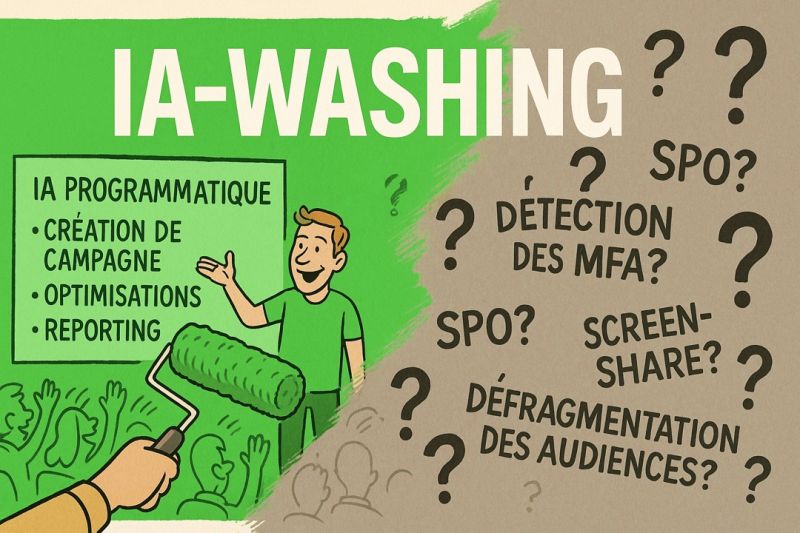
Everyone in AdTech is talking about AI. Everyone seems to be using it. But how much of this revolution is genuinely new—and how much is just a fresh label on familiar algorithms? 🕵️
1. What is AI-washing in AdTech?
Imagine taking a familiar product feature, replacing the words algorithm or lookalike modeling with AI, adding a shiny new label and presenting it as a breakthrough. Voilà! You've got yourself an “AI-powered” solution. 😉
That is the risk behind AI-washing in programmatic advertising: an AI claim that is broader than the actual technical novelty or demonstrated benefit. It does not mean every vendor using the term AI is misleading buyers. It means buyers should ask what the technology actually does, how it differs from previous methods and whether the difference improves outcomes.
The distinction matters because automation, statistical modeling, machine learning and generative AI are related concepts, but they are not interchangeable. A sophisticated optimization algorithm can be useful without being a newly invented AI agent.
2. Hasn't programmatic advertising used algorithms for years?
Of course it has. Predictive bidding, audience scoring, lookalike modeling and automated budget allocation all predate the current generative AI boom.
That history does not make today's AI developments irrelevant. New language interfaces, reasoning-oriented workflows and tool-using agents may make previously cumbersome tasks easier to perform (although the existence of an AI interface is not evidence of incremental campaign performance).
So the right question isn't simply “Does this platform use AI?” It is “What can it do now that it couldn't do before, and how do we measure the improvement?”
3. What is prompt-to-campaign in programmatic advertising?
Here is the genuinely intriguing possibility: instead of configuring every step through a DSP interface, a Media Trader describes a campaign objective in natural language. An AI assistant or agent then helps translate that brief into a media plan, targeting choices, campaign settings, optimizations and reports.
That's the idea behind prompt-to-campaign. In its most ambitious form, agents could manage much of the workflow autonomously. In more realistic near-term implementations, a human still approves budgets, targeting, creatives, exclusions and material changes before activation.
| Workflow | Conventional approach | Potential AI-assisted approach |
|---|---|---|
| Campaign brief | Manual translation into DSP settings | Natural-language brief converted into a draft configuration |
| Planning | Manual research and exports | Agent-supported comparison of eligible supply and targeting options |
| Optimization | Trader reviews dashboards and adjusts settings | Suggested actions with explanations and approval controls |
| Reporting | Exports, spreadsheets and commentary | Automated summaries linked to verifiable source metrics |
These are possible workflows, not a claim that every DSP already offers them end to end. Integrations, permissions, data quality and auditability determine what can safely be automated.
4. Three questions the AdTech industry needs to answer
Does AI create measurable incremental value? Saving time is valuable. But when vendors promise better campaign performance, buyers need a meaningful baseline, comparable conditions and evidence of incremental improvement—not merely a slick demo.
Will AI replace Media Traders? It may automate repetitive setup, analysis and reporting tasks. That does not automatically replace the judgment needed to challenge metrics, investigate supply quality, interpret business goals or manage commercial trade-offs. Our article on what Media Traders can learn from Paid Search explores why those skills still matter.
How much control should advertisers delegate? An autonomous agent making decisions about real advertising budgets needs clear permissions, spending limits, approval thresholds, change logs and the ability to stop or reverse actions.
5. How can advertisers spot AI-washing?
Before paying a premium for an “AI-powered” AdTech solution, ask a few practical questions:
- What's genuinely new? Ask the vendor to distinguish established predictive models from new generative or agentic functionality.
- What data does it use? Clarify data sources, access rights, privacy constraints and potential blind spots.
- What decisions can it make? Separate recommendations from actions executed without human approval.
- How is success measured? Compare against a credible baseline using the same campaign objectives and quality constraints.
- Can decisions be audited? Require traceable settings, spend changes, logs and understandable reporting.
For a practical example of questioning a black-box tool, see our guide to Reverse Analytics. For the broader issue of opaque algorithms, read Are DSPs really optimizing my campaigns?
6. Evolution, revolution or mirage? Our guest article for Open Garden
These questions are at the heart of a GreyFox Ads guest article published by Open Garden, a French publication covering programmatic advertising and the wider AdTech ecosystem.
We explore the gap between the marketing narrative surrounding AI and the operational changes that could genuinely reshape media buying. The full guest article is available in French on Open Garden.
A big thank-you to Nicolas Jaimes for once again inviting GreyFox Ads to contribute to the conversation. 🙏🇫🇷
7. The GreyFox Ads perspective: efficiency before buzzwords
Here in France, we believe that the real test of innovation is whether it helps advertisers buy better media—not whether a product has the most fashionable acronym.
At GreyFox Ads, our Master Curated Deal brings together high-quality French Open Web supply, Supply Path Optimization, MFA exclusions, brand safety safeguards, attention-conscious ad formats, addressability and transparent programmatic fees.
Our focus is practical: help agencies and Media Traders buying the French market achieve more efficient, understandable campaigns. AI may support that mission, but it does not replace the need to scrutinize results.
Further reading: GreyFox Ads guest article in Open Garden (French) · Original French LinkedIn post.
Looking for a programmatic advertising partner in France?
Want to improve the quality, efficiency and transparency of your Display and Video campaigns on the French Open Web? Let's talk.
Contact GreyFox AdsDiscover the Master Deal