Why Media Traders Should Learn from Paid Search
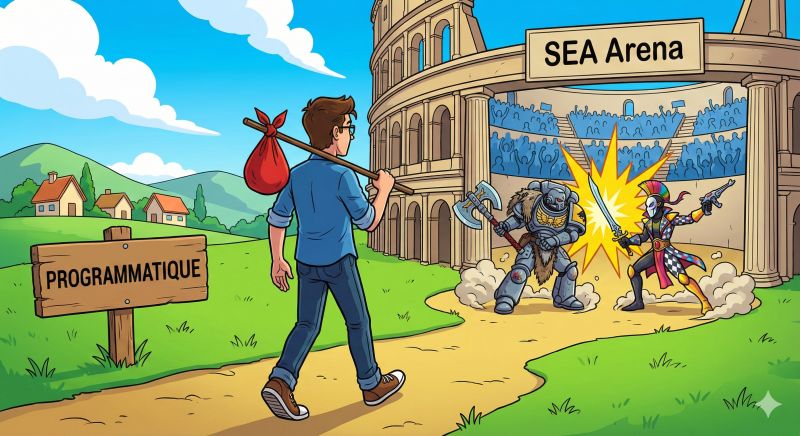
Happy New Year 2026! 🎉 Welcome back to Season 2 of our programmatic series. We've been preparing nearly 20 new articles—and our first New Year's resolution is simple: Media Traders should spend more time learning from Paid Search. ✈️
1. Why should programmatic traders learn from Paid Search?
As the saying (almost) goes: travel broadens the mind—especially when programmatic traders venture into Paid Search. 😉
Paid Search is one of the best training grounds for anyone buying digital media. Instead of spending all day discussing video completion rates or MRC viewability, Search specialists constantly ask whether advertising generated conversions, revenue and a measurable return on investment.
Here in France, Paid Search accounted for 41% of digital advertising investment in 2024, or €4.48 billion, according to the French digital advertising industry report published by SRI (figures cited from the 2024 reporting period; categories and measurement methodologies can differ across markets).
That is a lot of money riding on one very practical question: What did the advertiser get back?
2. From media delivery metrics to real business outcomes
Programmatic branding teams often optimise CPM, viewability or video completion rate (VTR). These are useful operational signals—but none is a business outcome on its own.
Paid Search encourages a different reflex: connect media decisions to post-click conversions, acquisition costs, revenue or other advertiser-defined results. For upper-funnel campaigns, that may mean brand lift, attention, incremental reach or properly designed effectiveness studies rather than forcing every impression into a last-click ROI calculation.
Our article on why viewability alone is not enough explores the same problem from the programmatic side. A technically viewable impression is not necessarily an impression that creates value.
3. Paid Search is a giant casino 🎰
In Search, you are competing against other advertisers bidding for the same keywords and audiences—and against the rules of the auction platform, which sets the mechanics of the game. The house, in this analogy, is Google. 🎲
The analogy is deliberately playful: advertising auctions are not games of pure chance. Yet they reward the same discipline as any competitive market—understanding incentives, assessing competitors, interpreting signals and knowing when a bid is no longer worth its price.
Programmatic auctions have their own complexities: intermediaries, supply paths, inventory duplication, floors, filtering and limited visibility into some transactions. That's why the questions raised in our Transaction ID analysis matter so much.
4. Four Paid Search skills every Media Trader should master
| Paid Search discipline | Transferable programmatic lesson |
|---|---|
| Large-scale data analysis | Work confidently with exports containing 100,000+ rows, Pivot Tables, XLOOKUP, conditional formatting and structured reporting. |
| Competitive intelligence | Understand auction pressure, buyer behaviour and how platform rules affect buying opportunities (competitor budgets are usually estimates, not directly observable facts). |
| CPC and Quality Score optimisation | Improve targeting, creative relevance and campaign structure instead of simply raising bids. |
| Continuous performance analysis | Identify wasted spend, test hypotheses and reallocate budgets to the strongest opportunities. |
When Search specialists manage thousands of keywords, spreadsheet fluency stops being optional. And with Google automating more campaign decisions, human expertise becomes less about clicking buttons and more about asking better questions.
Programmatic teams can apply the same curiosity through reverse analytics: compare inventory before and after a filter to understand what it actually changes.
5. How to bring a Paid Search mindset into programmatic buying
Here is a practical set of questions to bring into your next campaign review:
- Supply paths: Are we buying through the most efficient route to the publisher, or paying for unnecessary intermediaries?
- Inventory quality: Are our impressions delivered in trustworthy, useful environments rather than merely cheap ones?
- True media cost: Can we identify technology, data and intermediary fees across the chain?
- Attention: Are the formats large and engaging enough to stand a chance of being noticed?
- Incrementality: Are we reaching people we would not otherwise reach?
- Measurement: Do our optimisation signals relate to the advertiser's actual business objective?
These questions are particularly important when a low CPM creates a false sense of efficiency. We explore that trap in our Programmatrix article.
For more on finding genuinely new audiences, see incremental targeting strategies.
6. How GreyFox Ads applies this mindset to the French Open Web
At GreyFox Ads, we are a French programmatic company with a simple philosophy: bring the performance-driven mindset of Paid Search to quality Open Web buying. That's our little secret sauce. 🤟
- Supply Path Optimisation (SPO): favour direct publisher routes and resellers with demonstrable added value.
- MFA prevention: exclude made-for-advertising sites and problematic subdomains.
- Brand Safety: use appropriate safeguards without confusing maximum blocking with maximum effectiveness.
- Ad format quality: look beyond binary viewability and evaluate the screen space occupied by display ads and video players.
- Advanced addressability: combine relevant cookie-based and cookieless methods, including consent-independent contextual targeting where legally appropriate (not a workaround for consent requirements).
- Fee transparency: make the cost chain easier to understand and optimise.
For agency teams outside France, our Master Curated Deal brings these principles together in one activation route to quality French Open Web inventory.
As we explain in our article on programmatic financial transparency, improving efficiency begins with understanding what you are paying for.
7. A New Year's resolution worth keeping
Programmatic efficiency is not about buying the cheapest impressions. It's about maximising the value of every impression purchased.
Paid Search does not have every answer. Branding campaigns need different measurement approaches from direct-response campaigns. But its culture of accountability, experimentation and rigorous data analysis is something Media Traders can—and should—borrow.
So here's our resolution for Season 2: less optimisation by dashboard habit, more optimisation by business impact. 🚀
Looking for a programmatic advertising partner in France?
GreyFox Ads helps agencies, trading desks and advertisers make French Open Web buying more efficient, transparent and effective.
Discover our Master DealContact GreyFox Ads