1.5-Party Data: How to Extend First-Party Audiences in Programmatic Advertising
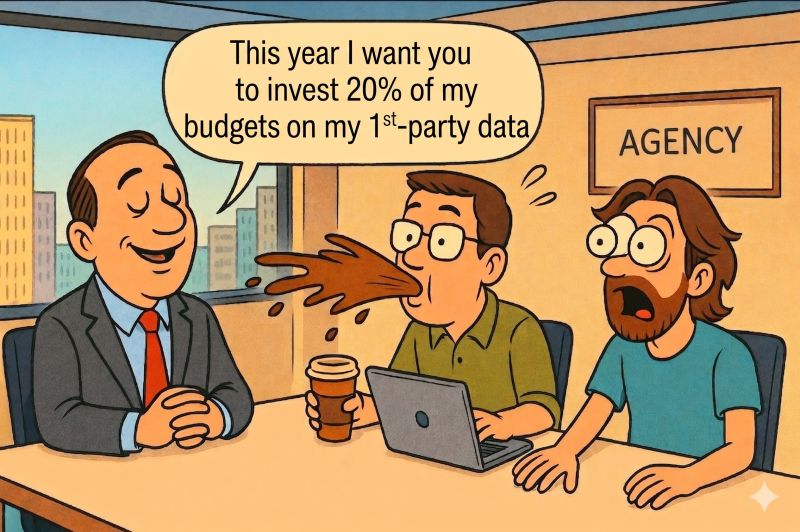
A Media Trader once told me: “For one of my FMCG advertisers, I have investment goals tied to their first-party data. The problem? Their website audiences are simply too small.” Sound familiar? 😉
Advertiser first-party data is precious: these are people who have already interacted with the brand. But what happens when there are not enough of them to sustain a campaign? Here in France, there is another pool worth exploring: 1.5-party data.
1. Why does first-party data reach saturation so quickly?
For advertisers, people who visit their websites have already shown an interest in their products or services. That makes these audiences especially attractive for retargeting and other lower-funnel tactics.
But the audience pool can be surprisingly small, particularly for FMCG brands that do not sell directly online. Even after expanding across devices, environments and formats, Media Traders can run into limited reach, rising frequency and diminishing incremental delivery.
That creates an awkward situation: the advertiser has set ambitious investment targets for first-party data, while the available audience cannot absorb the budget efficiently. Increasing frequency alone does not create new people to reach.
2. What exactly is 1.5-party data?
At GreyFox Ads, I use “1.5-party data” to describe audiences who consume content closely related to a brand outside that brand's own digital properties. Think of it as sitting between the advertiser's first-party audiences and the first-party audiences of retailers or publishers.
(The term is a useful industry shorthand, not a universally standardized data category. From a data-governance perspective, the retailer or publisher still collects and controls its own first-party data.)
| Audience approach | Where the signal originates | Illustrative example |
|---|---|---|
| Advertiser first-party | Advertiser-owned site, app or CRM | Someone who visited the brand's product page |
| “1.5-party” | Retailer or publisher content closely associated with a brand | Someone who views the brand's product listing or a review about its products |
| Broader contextual targeting | Page content or topic | Ads appearing alongside relevant product-category content, without necessarily identifying a returning audience |
The important distinction is brand relevance: a person researching a specific product on another website may be highly interesting to the advertiser, even if they have never visited the advertiser's own website.
3. Two examples from the French market
FMCG and retail: imagine visitors exploring Procter & Gamble product pages on French retailer websites such as Auchan, Carrefour, E.Leclerc or Lidl. These interactions may reveal purchase consideration that never appears in P&G's own website analytics.
Consumer electronics and media: consider readers consulting Samsung smartphone reviews or product tests on French technology publishers such as 01net, Frandroid or Les Numériques. They are engaging with brand-specific content even though they are not on Samsung's website.
These are illustrative audience opportunities, not claims that each named retailer or publisher currently sells the corresponding brand-level segments. Actual availability, permitted uses and targeting granularity must be checked with each data owner.
4. Why complement first-party data with these audiences?
For brands struggling to scale their own first-party audiences, the opportunity is twofold:
- Extend qualified reach: engage people who are already considering the brand's products, but have not visited its owned channels.
- Protect share of voice: remain visible during research and comparison moments, when competing brands may also be advertising.
There is also a strategic benefit for Media Traders: separating existing customer or site-visitor audiences from brand-relevant publisher audiences makes it easier to manage frequency and assess whether the extra reach is genuinely incremental.
That connects naturally to our article on incremental targeting and avoiding unnecessary data costs. Paying for an audience signal makes sense when it adds value beyond what a simpler contextual or whitelist strategy could deliver.
5. How can Curator Seats help activate 1.5-party data?
Retailers and publishers own valuable audience signals, but an advertiser often needs to reach those people across more than one site. This is where programmatic curation can play a role.
Through suitable Curator Seats and data partnerships, retail media and publisher players — including French market participants such as Unlimitail and Valiuz — can help package audience strategies into curated supply opportunities, potentially reaching buyers through supported DSP integrations.
(Cross-site activation is not automatic: it depends on the partner's contractual rights, consent or other lawful basis, technical matching, identifier availability, platform support and the actual supply included in the deal.)
For a closer look at why publishers invest in this infrastructure, read our article on why French publishers open their own Curator Seats.
And for browser-related constraints, our analysis of Safari and cookieless inventory in France explains why addressability and reach still matter after an audience strategy has been defined.
6. A practical checklist for Media Traders
| Question | Why it matters |
|---|---|
| Is the segment genuinely brand-specific? | A broad category audience is not equivalent to a brand product-page visitor. |
| Can the data owner authorize the intended activation? | Collection, sharing, targeting and measurement require an appropriate legal and contractual framework. |
| What is the addressable reach in the chosen DSP? | Segment size before matching can overstate real campaign reach. |
| How much does the audience cost? | Measure the total CPM, including data and curation fees, not just media CPM. |
| Does the segment add incremental people or outcomes? | Compare against advertiser first-party, contextual and broader prospecting tactics. |
The goal is not to buy more data for the sake of it. It is to invest more intelligently in audiences with meaningful brand affinity, without losing control of cost, reach or transparency.
7. GreyFox Ads: connecting international Media Traders with the French Open Web
At GreyFox Ads, we believe a quality Open Web can deliver real advertising efficiency. We help Media Traders outside France activate campaigns in the French market by combining local expertise, clean supply, smart targeting and cost transparency into one Master Curated Deal.
Interested in the mechanics behind this approach? Discover our programmatic curation expertise.
Looking to activate smarter audience strategies in France?
GreyFox Ads helps international Media Traders reach quality French Open Web inventory with simpler, more transparent programmatic activation.
Contact GreyFox AdsExplore our Master Deal