Programmatic Advertising: How to Unlock Safari Inventory in France
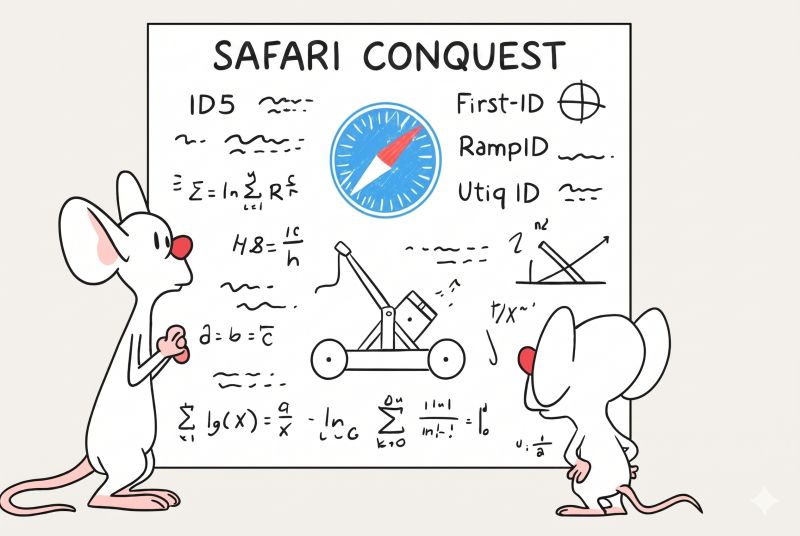
What if one of the most interesting audiences in the French mobile web were also one of the most overlooked in programmatic media plans? 🍎
When Alliance Digitale presented its 2025 programmatic barometer, one number caught my attention: only 10% of mobile-web programmatic investment was attributed to Safari, according to the figures cited in that presentation. Meanwhile, Safari represented 32% of French mobile-web traffic, according to the Similarweb figure referenced in my original analysis.
Safari's share of traffic and investment: a striking gap
In the figures I cited for the French market, Safari represented 32% of mobile-web traffic but attracted only 10% of mobile-web programmatic investment. Those percentages come from different sources and denominators, so they should not be read as a precise measurement of underinvestment on a like-for-like basis. Still, the contrast raises a useful question: are media-buying practices leaving valuable Safari inventory behind?
| Indicator | Figure cited | Context |
|---|---|---|
| Safari share of French mobile-web traffic | 32% | Similarweb figure cited in the original analysis |
| Safari share of mobile-web programmatic investment | 10% | 2025 Alliance Digitale barometer figure cited in the original analysis |
| Chrome share of programmatic investment | 90% | Figure cited in the original post; scope and comparability require confirmation |
Safari users may also be attractive for some advertisers in terms of purchasing power (although browser choice alone does not establish a user's income, and this varies by audience and campaign).
Why Safari is harder to activate with traditional programmatic targeting
Safari blocks third-party cookies by default through Apple's privacy protections. For media buyers still relying heavily on third-party cookies, that complicates cross-site audience recognition, frequency management and attribution.
The result can be a bias towards inventory where established identifiers remain more available. That may concentrate bidding pressure on other browsers, particularly Chrome (although the size of any resulting CPM inflation must be measured rather than assumed).
We've previously discussed this broader issue in our analysis of the three faces of the Open Web: consented, cookieless and non-consented audiences. Safari is one important part of that fragmented ecosystem.
Which alternative identifiers can help reach Safari users?
Several identity solutions can support addressability beyond third-party cookies. But they are not equivalent: each has its own technical design, eligibility requirements, coverage and privacy constraints.
| Solution | Approach | Consideration for buyers |
|---|---|---|
| ID5 and First-ID | Alternative identity frameworks designed to support publisher and advertiser addressability | Evaluate real match rates, consent requirements, deployment and DSP compatibility; do not assume all implementations rely on the same signals |
| LiveRamp and EUID | Identity approaches that can use authenticated or consented signals | Potentially useful for recognized audiences, with reach constrained by available eligible signals |
| Utiq | Telecom-based identity solution operating with participating partners | Coverage depends on supported operators, publishers, user choices and consent |
These approaches should not be confused with unrestricted fingerprinting. Privacy compliance and the availability of lawful, appropriate consent are fundamental. Nor can any alternative ID be assumed to be as robust as third-party cookies for every use case: accuracy, scale, frequency capping and measurement all require independent testing.
How to build a dedicated Safari activation strategy
- Measure the baseline. Break down reach, spend, CPM, viewability and conversions by browser, device and consent status where reporting permits.
- Audit addressability. Check which alternative IDs and contextual signals your DSP, SSP and publisher partners can actually pass and activate.
- Test complementary targeting. Combine eligible alternative identifiers with contextual and publisher first-party signals, rather than depending on a single ID.
- Control supply quality. Favor transparent publisher paths and exclude MFA inventory. Our analysis of resellers and supply path optimization explains why this matters.
- Compare incremental outcomes. Measure whether Safari activation adds useful reach and business impact without simply shifting impressions between browsers.
A curated approach can simplify the activation of multiple inventory sources and targeting methods. For publishers, a Curator seat can also support audience extension and inventory enrichment, depending on the commercial and technical setup.
The real challenge is not just technology. It's reach.
In the French mobile web, Safari should not be an afterthought. Alternative identity solutions exist, but usable scale is what determines whether they can deliver value in a real campaign: how many users can be addressed, through which supply paths, under which permissions, and with what measurable results?
At GreyFox Ads, we believe the quality French Open Web can deliver genuine advertising efficiency. We may be the smallest ad network in France — but not the least ambitious. Our Master Deals are designed to give Media Traders cleaner supply, smarter targeting, simplicity and transparent costs.
- Alliance Digitale, 2025 programmatic barometer (figures as quoted in the original post; check the study's exact reporting scope before reusing in external comparisons).
- Similarweb, French mobile-web browser traffic (figure cited in the original post; date and measurement methodology not supplied).
- Original LinkedIn post by Max Legrand.
Want to unlock premium Safari inventory in France?
Explore a smarter, more transparent approach to video and display programmatic buying across the French Open Web.
Contact GreyFox AdsDiscover our Master Deal