Transaction ID in Programmatic: Why Is It So Controversial?
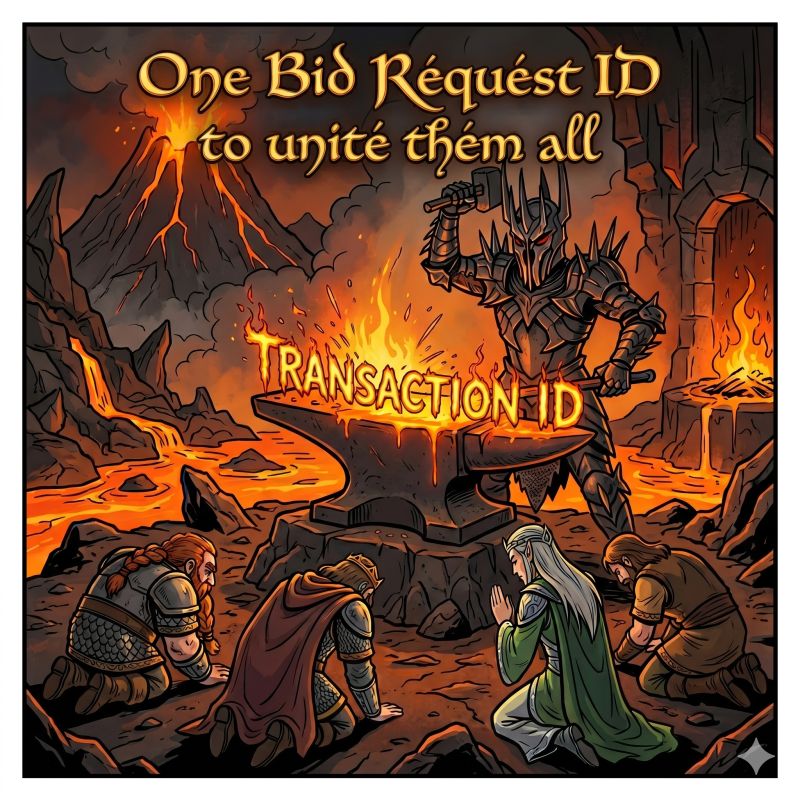
One impression opportunity. Several SSPs. Multiple bid requests landing on a DSP's doorstep. Welcome to one of the Open Web's most frustrating technical puzzles: bid duplication. Could the Transaction ID solve it? And why has that seemingly sensible idea become controversial? 🤔
1. Why did bid duplication become such a big issue?
A few years ago, publishers discovered a simple way to increase their exposure to programmatic demand: connect more SSPs and selling seats. One underlying ad opportunity could then reach a DSP through several different supply paths.
In theory, broader demand access can improve competition. In practice, repeated bid requests can make the available inventory appear larger than the number of distinct opportunities (the extent depends on the auction architecture and how each platform handles duplicates).
The issue becomes even more complex when the same SSP is connected through multiple seats. As discussed in our analysis of resellers, duplicate bid requests and SPO, more supply paths do not necessarily mean more incremental value for the publisher.
SSPs have responded in part through bid-request throttling: reducing the volume of auctions forwarded when processing costs outweigh expected revenue. But throttling does not automatically tell a buyer which paths represent the same opportunity.
2. What is a Transaction ID (TID) in programmatic advertising?
A Transaction ID is an identifier associated with an auction opportunity that can be passed through the programmatic supply chain. When multiple SSP paths preserve a common TID for the same opportunity, a DSP can potentially recognize those requests as related rather than treating each one as entirely independent.
| Without a shared TID | With a shared TID |
|---|---|
| SSP A sends bid request A; SSP B sends bid request B. | Both paths can carry a common auction-level identifier. |
| The DSP may struggle to identify that the requests concern the same opportunity. | The DSP can more easily compare supply paths for that opportunity. |
| Duplicate processing and fragmented path analysis may persist. | Deduplication and SPO become more technically feasible, subject to implementation. |
This is why The Trade Desk has advocated for transaction-level transparency: buyers want to distinguish genuinely incremental access from repeated requests for the same impression.
One important distinction: a TID is not a universal user ID. Its purpose is to describe an auction or transaction opportunity, not to identify a person. Its value for deduplication depends on how consistently it is generated and passed along.
3. Why did Prebid's handling of TID become controversial?
Here comes the plot twist. 🎬 Prebid, widely used in header bidding, has faced competing demands: preserve a shared transaction signal for buyers while limiting what different auction participants can infer from it.
My original analysis highlighted a debate over SSP-specific versus shared transaction identifiers. If each SSP receives a different value for what is effectively the same auction opportunity, the DSP loses much of the cross-path deduplication benefit.
But a single identifier shared widely can also allow parties to correlate information they would otherwise see separately. Prebid's treatment of transaction IDs has evolved, with publisher configuration and privacy considerations playing a role (the exact behavior depends on the Prebid version, configuration and integrations in use).
So the disagreement is not simply “transparency versus secrecy.” It is about who can correlate which signals, for what purpose, and under whose control.
4. What does data leakage have to do with Transaction IDs?
Imagine an intermediary sees the same TID alongside different identifiers or contextual signals arriving through several paths. It might be able to infer relationships between those signals. This is the data-linkage risk behind the debate.
My view? We should not abandon a useful SPO mechanism without first asking whether access controls, minimization and appropriate handling of user identifiers can reduce the risk. 🔒
However, encrypting or hashing user identifiers alone is not a complete solution: persistent or linkable pseudonymous values may still allow correlation. Privacy protection also depends on consent, contractual restrictions, data minimization, retention, technical design and applicable law.
In other words, the goal should be better supply-chain transparency without creating a new shortcut for user-level data enrichment.
5. What should publishers, SSPs and Media Traders do?
For publishers, the first step is to map how many paths are selling the same inventory and to understand what transaction-level signals their header bidding setup exposes. For buyers, the challenge is to assess whether a supply path is genuinely incremental or simply duplicates access already available elsewhere.
| Stakeholder | Practical question |
|---|---|
| Publisher | Which SSP seats and reseller paths actually generate incremental revenue? |
| SSP / Prebid integrator | How is the TID generated, scoped and passed through the auction? |
| Media Trader / DSP | Can our buying platform detect overlapping auction opportunities and prioritize cleaner paths? |
| Privacy / data team | Could the identifiers being shared enable unintended correlation or data leakage? |
There is no magic checkbox that fixes every auction. But cleaner paths, clearer identifiers and transparent reporting can reduce waste. This complements the broader work of challenging DSP optimization rather than simply accepting a green dashboard.
6. GreyFox Ads: a cleaner route to the French Open Web
At GreyFox Ads, we believe quality Open Web inventory can deliver real efficiency for advertisers. We help Media Traders outside France activate the French market through a single Master Curated Deal, combining local market expertise, cleaner supply, smarter targeting and cost transparency.
Because buying the same opportunity through ten different doors does not make it ten times more valuable. 😉
Original LinkedIn post: Read the original post by Max Legrand.
Want cleaner programmatic supply in France?
Looking for quality French Open Web inventory, simpler activation and transparent costs? Let's discuss your next campaign.
Contact GreyFox AdsDiscover our Master Deal