Why are advertisers both comfortable and uncomfortable with Walled Gardens?
A few weeks ago, we were invited to give a keynote on “How to Save the Open Web”.
At the end of the presentation, we had an exchange with some advertisers that spoke volumes about the Open Web's current situation.
Advertisers: “It's reassuring to hear your assessment of advertisers investing more and more in Walled Gardens. Well... it's reassuring and worrying at the same time...” (awkward laughter)
But how on earth do you explain that paradox? 🤔
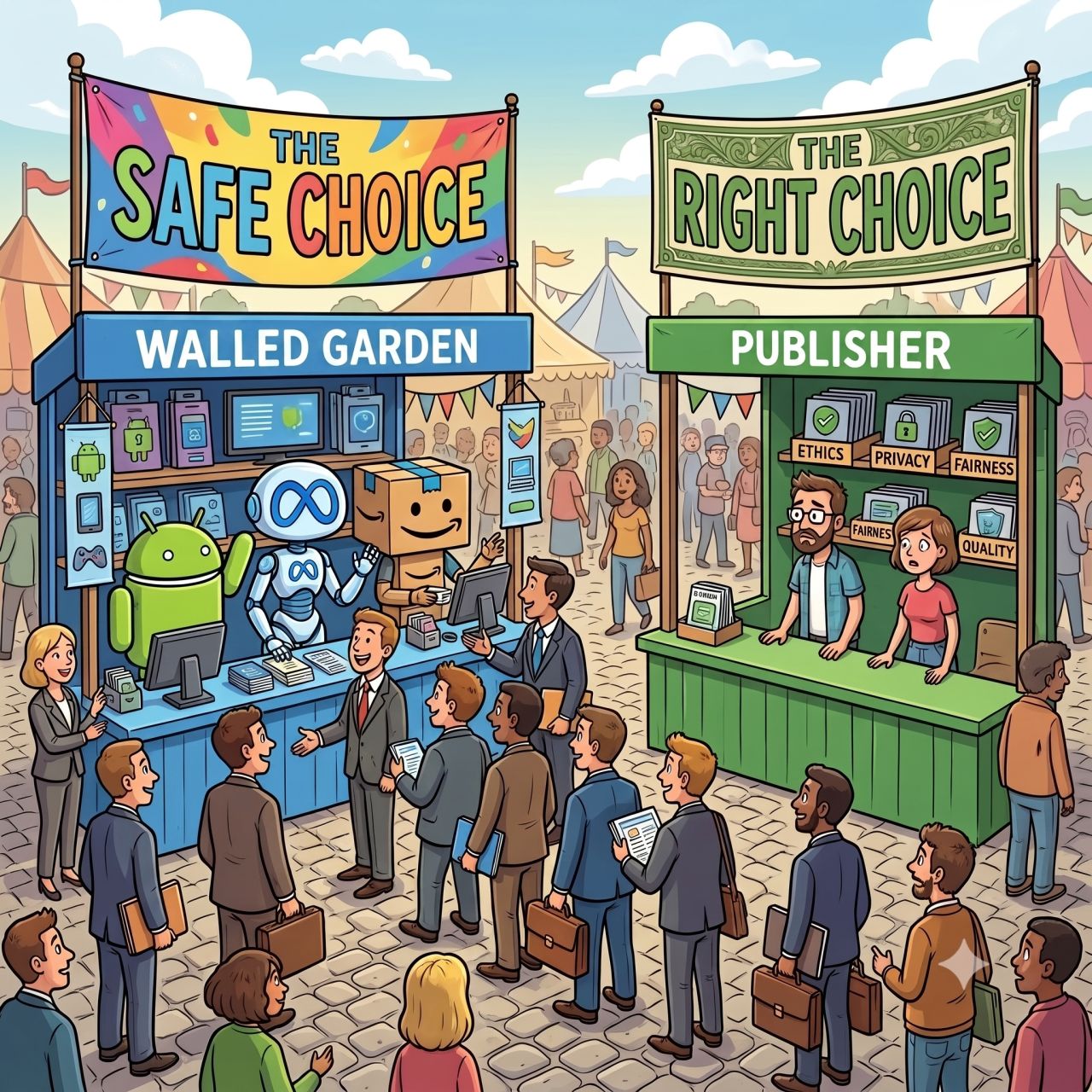
It's the whole “Right Choice” vs “Safe Choice” dilemma ⚖️
What is the difference between a “Safe Choice” and a “Right Choice” in media buying?
🛡️ Safe Choice means following “everyone else's example”. It is a decision that feels professionally defensible because it fits the dominant market practice.
❤️ Right Choice is the choice that makes the most sense based on your own convictions, objectives and judgement — even when it goes against that practice.
| Question | Safe Choice 🛡️ | Right Choice ❤️ |
|---|---|---|
| Decision logic | Follow what the market usually does | Follow your own assessment of what makes sense |
| When results disappoint | “Everyone else does this too” is easier to defend | A departure from the norm can be harder to explain |
| Potential weakness | Market consensus is not proof of effectiveness | Personal conviction is not proof of effectiveness either |
| What the buyer needs | Evidence that the default choice actually delivers value | Evidence and an operationally credible reason to depart from the default |
These are descriptions of the decision-making dilemma in our original post, not fixed classifications of advertising channels. An Open Web campaign can be a safe choice; a Walled Garden campaign can be the right choice for a specific objective.
Why does a 75% Walled Garden budget feel safer than a 75% Open Web budget?
Put yourself in a marketing director's shoes. Two scenarios, same disappointing performance, very different career-risk perceptions:
| Illustrative scenario | 🛡️ Safe Choice: 75% Walled Gardens | ❤️ Right Choice: 75% Open Web |
|---|---|---|
| Budget allocation | You invest 75% of your advertising budget in Walled Gardens. | You invest 75% of your advertising budget in the Open Web. |
| Campaign outcome | You struggle to hit your performance targets. | You struggle to hit your performance targets. |
| Market comparison | But the whole market is doing the same thing. | But you've done the exact opposite of the market. |
| Perceived consequence | Nobody will give you a hard time 👍 | You're in the ejector seat 💺🪂 |
The 75% figures are hypothetical examples used to illustrate the difference in perceived professional risk. They are not reported data on actual media budget allocations or proof that one channel performs better.
In other words, the risk a marketing director feels is not always the same as the risk the business actually takes. A decision can be easy to justify internally without being optimal for the advertiser.
Why can advertisers be reassured and worried by the same market figures?
The result:
- Advertisers feel reassured when they discover the market figures, because they prove that, individually, they made the “Safe Choice” 🥳
- At the same time, they're worried (to a lesser extent), because the figures suggest that, collectively, the entire market is heading in the opposite direction to where — in their view — it should be going 🤯
Moral of the story: ✅🛡️⚖️❌👌
The interesting part is the tension between individual reassurance and collective concern. Established platforms also have real advantages: scale, integrated tools and straightforward activation. Still, widespread adoption does not automatically establish that they are the most effective choice for every advertiser or every campaign.
For a related look at the French market, explore our analysis of why the Open Web needs a stronger advertising value proposition.
How can the Open Web become the “Safe Choice” for advertisers?
The solution: if we want to reverse the situation, there's no point trying to persuade advertisers to make the Right Choice just because it is the “right” thing to do. That's a losing battle 🏳️
📈 Instead, we need to move from being the “Right Choice” to becoming the “Safe Choice”. And that requires profound changes to the value proposition — the argument developed in our original post.
What could that mean operationally for the French Open Web? Drawing on our broader Open Garden analysis on how to repair the Open Web, here are five practical levers:
- Make buying simpler: reduce unnecessary complexity in deal activation, deal IDs and campaign setup.
- Prove inventory quality: demonstrate which sites, formats and supply paths are being bought, and avoid low-value ad-clutter or Made-for-Advertising (MFA) inventory.
- Measure meaningful effectiveness: assess attention, incremental reach and advertiser outcomes, rather than equating viewability with impact.
- Make fees understandable: be transparent about intermediaries and explain the value delivered at each step.
- Make testing easy to defend: use clear hypotheses, comparable metrics and transparent reporting so marketing teams can explain their decisions internally.
These are practical proposals, not a guarantee of higher ROI. For more detail, see our analyses of attention and the Open Web and financial transparency in programmatic advertising.
The point is not to oppose Walled Gardens on principle. It is to make an Open Web investment credible, measurable and easy to justify — including when campaign performance needs to be challenged.
What is GreyFox Ads doing to make the French Open Web easier to buy?
At GreyFox Ads, we're convinced that quality French Open Web inventory delivers real effectiveness for advertisers.
We sell two complementary offers:
- To Media Traders: a Swiss Army knife Master_Deal_ID designed to solve A LOT of the programmatic ecosystem's problems 👑 — by bringing inventory selection, targeting, quality controls and transparency together in a single curated deal.
- To Programmatic Sales Houses: consulting assignments on programmatic and Curation 💡.
We want the Open Web to be more than an option that appeals to advertisers' convictions: we want it to become a choice they can confidently recommend to their management teams.
Want to work with a quality partner? 📧 Contact GreyFox Ads!
Sources and further reading
- Original GreyFox Ads LinkedIn post — the keynote anecdote and Safe Choice vs Right Choice argument.
- The linked argument about changing the value proposition — as referenced in the original post.
- Open Garden — What broke the French Open Web and how to repair it (11 February 2026; original in French).
- GreyFox Ads — How to revive the French Open Web.
- GreyFox Ads — What is programmatic curation?
Editorial clarification: the two 75% allocations are fictional illustrations from the original post. No market-average budget split, incrementality test or scientific risk model is claimed here. The five operational levers are an editorial expansion informed by GreyFox Ads’ related Open Web analysis.