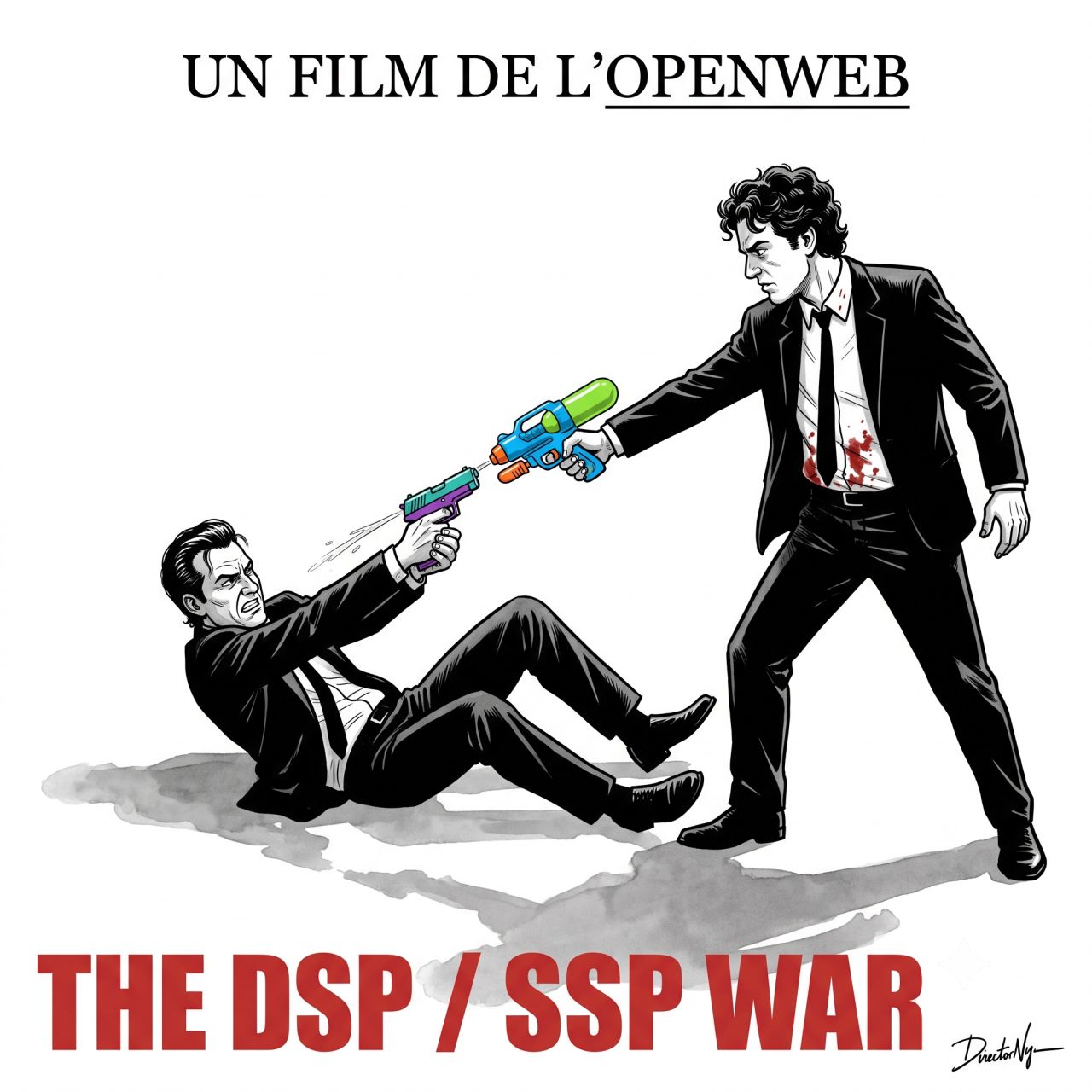
How did DSPs and SSPs originally work together?
Ten years ago, nobody would have imagined a conflict between DSPs and SSPs.
🎯 Each technology had a clear purpose: a DSP represented the interests of advertising buyers, while an SSP represented the interests of publishers and resellers.
| Role | DSP — Demand-Side Platform | SSP — Supply-Side Platform |
|---|---|---|
| Primary customer | Advertisers, agencies and Media Traders | Publishers, sales houses and sometimes resellers |
| Traditional mission | Buy the right impressions and optimise the advertiser's budget | Expose and monetise inventory across available demand |
| Historic competition | Several DSPs competed for agency budgets | Several major SSPs competed for the highest position in publishers' waterfalls |
| Mutual dependency | Needed SSP access to publisher inventory | Needed DSP demand to fill auctions and generate revenue |
🤝 DSPs needed SSPs... and vice versa!
But that... was then 💔
A waterfall is the older sequential approach to calling demand sources. Header bidding helped move competing sources into more simultaneous auctions — one reason the historical DSP/SSP division became less rigid.
What has changed between DSPs, SSPs and publishers?
The way the market operates has evolved:
- 💰 A small number of DSPs now account for the bulk of agency budgets. This concentration gives major buyers' platforms substantial negotiating power.
- 🔌 SSPs are connected to “99% of publishers” thanks to header bidding — the shorthand used in our original argument to illustrate how widely exchanges are already integrated. (The 99% figure is not a verified market census and should not be treated as a precise penetration rate.)
- 📉💰 Open Web investment is under pressure. In the French market, our concern is that the pool of available investment is not expanding in line with all these competing technology layers. (This is our market assessment, not a claim that every Open Web segment declines every year.)
📈💰 To keep revenues afloat, each technology is now trying to disintermediate the other ⚔️
Programmatic disintermediation means removing, bypassing or absorbing one or more intermediaries between advertisers and publishers. It can simplify buying — but it does not automatically eliminate fees or improve campaign outcomes.
How are SSPs trying to bypass traditional DSP buying workflows? ♕
In our view, SSPs are betting on two approaches:
1. Curation platforms and sell-side decisioning
Under the banner of “Sell-Side Decisioning”, SSPs let Curator Vendors select, enrich and package inventory using data, semantic targeting, verification and other layers of added value. The resulting Curated Deals can make an SSP's supply more attractive to DSP buyers and channel more investment through that marketplace.
In other words, the SSP is no longer just putting inventory up for auction: it is helping build the advertising proposition itself. For a practical explanation, see what curation and Curator seats actually do.
A curated deal does not technically oblige every DSP to purchase from a given SSP. The buyer still decides whether to activate and bid on it; the commercial goal is to influence that decision through value added to the supply.
2. Direct-buying platforms
SSPs are also building self-service, Walled-Garden-style buying interfaces centred on their own inventory. Instead of requiring every agency to buy through a separate DSP, these platforms can offer more direct access to the SSP's supply.
Two concrete examples are PubMatic Activate and Magnite ClearLine (both presented by their operators as more direct buying routes; their scope and features differ).
That is the paradox: technologies built to sell media are increasingly also trying to own the interface through which media is bought.
How are DSPs and other buying ecosystems shortening the supply path? ♚
DSPs, meanwhile, are betting on direct integrations — or, more broadly, on supply routes that keep buying relationships closer to the platforms.
Our original post named four examples. They illustrate related strategies, but they are not four technically identical DSP-to-publisher connections:
| Platform | Route mentioned in the original post | What it actually illustrates |
|---|---|---|
| DV360 → Google AdX (SPO) | A more integrated route within Google's buying and exchange ecosystem. (Not the same thing as a standalone DSP-to-publisher direct connector.) | |
| The Trade Desk | OpenPath | A documented direct connection between The Trade Desk and participating publishers, designed to reduce intermediaries. |
| Criteo | Its direct connector | Publisher connectivity and commerce-focused demand, including Commerce Grid. (Criteo operates across the buy- and sell-side boundary, so this is not a pure DSP model.) |
| Amazon | Its TAM wrapper | Transparent Ad Marketplace is a server-side header-bidding solution from Amazon Publisher Services, not strictly a DSP bypassing SSPs. |
The common logic is supply-path optimisation (SPO): identify routes with less duplication, fewer unnecessary hops and a clearer economic role for each participant.
Distinguishing these architectures matters. Some shorten the buying path, others centralise auctions or connect demand more directly. The commercial direction may converge even when the technologies do not.
What are the economic benefits — and risks — of disintermediation?
Disintermediation has some significant advantages:
- 📉💸 Cost optimisation: cut out intermediaries to reduce selling prices or preserve more of the advertiser's spend for the publisher.
- 📈💰 Upselling: charge for the new service while presenting it as less expensive than the previous intermediated route.
- 🎯💰 Concentrating spend: try to create a Walled Garden — or at least a controlled marketplace in which more budgets circulate through your own technology.
But the word direct is not a synonym for better. A shorter route can still carry platform fees, fewer competitive bids, or limited visibility into the final publisher price. And a curator can genuinely add value when it brings differentiated audiences, quality controls or better campaign outcomes.
This is why the debate should be about incremental value, fee transparency and measurable effectiveness, rather than the number of intermediaries alone. Our related analysis examines why publishers are unhappy with some curation economics — and why simply attacking curation can miss the point.
Who will win the DSP versus SSP tug of war? 🤼
You might think it'll be the DSPs, because they have several advantages:
- It is easier to persuade a handful of very large publishers to add yet another integration than to persuade major trading desks to change their buying technology.
- Some have exclusive assets, including inventory or data.
- Building platforms for buyers is already their area of expertise.
But the truth is... there might not be a winner 😮
Not in a market that's shrinking year after year... (Our concern here is specifically the economic pressure on parts of the French Open Web, not a universal forecast for all digital advertising.)
Winning more share of a shrinking pie is not necessarily a sustainable strategy. DSPs and SSPs can both improve their respective positions without solving the underlying problem: why should advertisers invest more in the quality Open Web in the first place?
What are the two possible strategies for programmatic platforms and the Open Web?
We see two possible strategies:
- Pivot away: move into other opportunities — CTV / Audio / DOOH / GEA, as listed in the original post — rather than relying only on traditional Open Web display and video investment.
- Stay and tackle the underlying problems: kick-start a radical transformation of the Open Web, with a better proposition for advertisers. We have argued for this in our earlier analysis of what needs to change.
The first route is diversification. The second is harder, because it means working on outcomes and incentives rather than merely redesigning the supply chain. We explored that second option in our article on how to revive the French Open Web.
What should advertisers, agencies and publishers actually ask?
- Does this supply path deliver incremental access to relevant inventory, or mainly the same impressions through another connection?
- What part of the buyer's CPM reaches the publisher, and which fees pay for real value?
- Does the new route improve campaign effectiveness, including attention, quality and addressability — not just a lower nominal fee?
- Can Media Traders activate, troubleshoot and report the deal easily? (See our article on the hell of debugging Deal IDs.)
These are practical questions we would ask when evaluating a new offer — not a claim that one model works best in every campaign. They also tie into the broader dilemma of making the Open Web the Safe Choice, not just the Right Choice.
How does GreyFox Ads approach quality French Open Web buying?
At GreyFox Ads, we're convinced that quality French Open Web inventory delivers real effectiveness for advertisers.
We offer two complementary services:
- To Media Traders: a Swiss Army knife Master_Deal_ID designed to solve A LOT of the programmatic ecosystem's problems 👑 — by bringing quality inventory selection, data and targeting, efficiency and transparency together.
- To Programmatic Sales Houses: consulting assignments on programmatic and Curation 💡.
The objective is not to win an abstract DSP/SSP battle. It is to make the Open Web simpler, more transparent and genuinely more effective for the advertiser — and more sustainable for the publisher.
Sources and further reading
- Original GreyFox Ads LinkedIn post — the DSP/SSP war argument, examples and conclusion.
- The Trade Desk — OpenPath (official platform description).
- PubMatic — Activate and Magnite — ClearLine (examples of direct-to-supply buying tools).
- Criteo — Commerce Grid and Amazon Publisher Services — TAM (different models of publisher access and auction infrastructure).
- Google — inventory sources in Display & Video 360.
- GreyFox Ads — the original link on transforming the Open Web proposition.
- GreyFox Ads — What is programmatic curation?
Editorial and methodological note: this article expresses GreyFox Ads' perspective on the French Open Web. The “99%” penetration figure and the long-term market decline are arguments from the original post, not independently verified market-wide statistics. The technical notes on TAM, OpenPath and Commerce Grid clarify differences between the examples rather than changing the original thesis. The historical original-post date was not provided; the date above refers to this English HTML update.