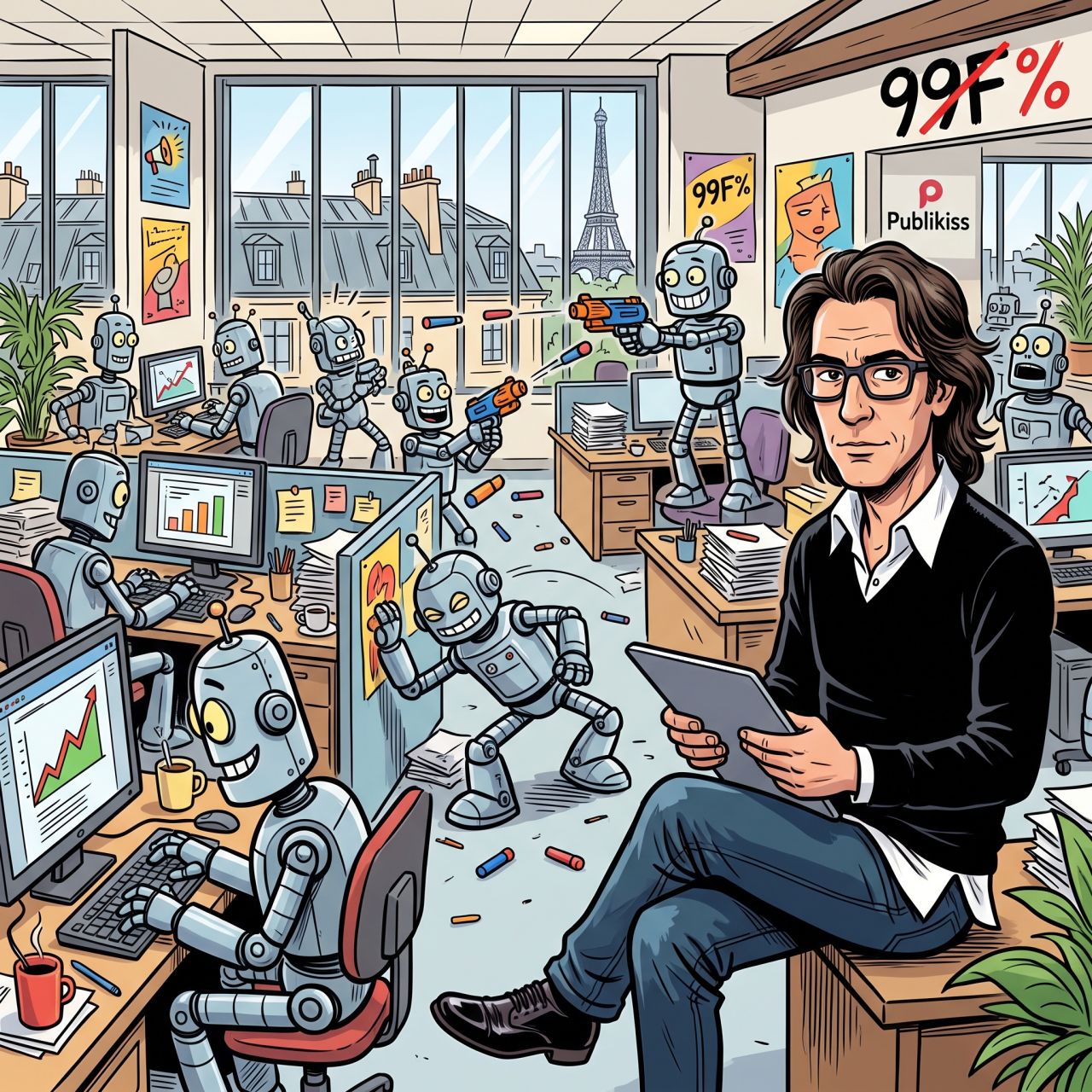
For several years, advertisers’ pitches have largely come down to one thing... price 💵
And the biggest cost for media agencies is... employees (AKA “talent”) 👩👨
To reduce that cost, we are seeing a familiar trend: 👦🏻 recruiting junior profiles and 🌏 offshoring low-value tasks.
The result? Some agencies offer very competitive fees — around 5%, as an illustrative order of magnitude rather than a market-wide average.
But what if, tomorrow, a new digital agency offered a fee of...
...1%? 😱 (Probably with an asterisk about legal risks and mistakes. 😉)
A scenario that seemed absurd just two years ago is becoming increasingly plausible thanks to agentic AI. Or is it?
Why could agentic AI transform the economics of media agencies?
For a traditional media agency, a large share of operating costs can be tied to people carrying out repeated tasks: campaign setup, trafficking, checks, pacing, reporting and troubleshooting. The exact proportion varies from agency to agency (and human expertise is not merely an overhead).
A largely agentic agency could theoretically have far fewer manual steps per campaign. A former senior Media Trader with well-documented operating procedures might therefore be able to launch a small, highly automated “discount” agency. 👀
That does not mean the technology autonomously owns a media budget or takes legal responsibility. It means the agency could rethink what needs to be performed by a person and what can be executed by a controlled system.
How would an AI agent actually run a programmatic campaign?
Put simply, a client could ask: “Set up a video campaign for me.” 👔
An agent built around one or more large language models (LLMs) would draw on specialised skills — the Media Trader’s professional expertise documented as reusable instructions, procedures, scripts or reference material. 💪
That last step matters: an agent needs approved access to the relevant ad platforms, validated data and the right permissions. A documented skill alone cannot place bids or guarantee a campaign will run successfully.
As Anthropic’s technical explanation of Agent Skills illustrates, specialised procedures can help a general-purpose model carry out domain-specific work.
In the agentic world, the new oil for media agencies... is skills! 🛢️
And this is why the difference between real automation and AI-washing matters: a flashy chatbot is not the same thing as a reliable end-to-end operating system.
Could an agentic agency really charge just 1%?
Imagine a former trader launching a lean agency with those skills. Here is the salary-cost illustration from the original GreyFox Ads analysis:
- 👦🏻 Senior Media Trader: €75,000 gross salary + €32,000 employer contributions = €107,000 a year, or approximately €8,900 per month.
- 🤖 Optimised AI agent: potentially far lower direct execution cost, provided its workflows use comparatively few tokens — but that is only one part of the cost picture.
And what would the fee difference look like? Consider a deliberately simple example of €1 million in billable media spend:
| Agency model | Illustrative fee | Agency revenue | Question to answer |
|---|---|---|---|
| Lower-fee conventional agency | 5% | €50,000 | Can operating costs be covered? |
| Hypothetical agentic agency | 1% | €10,000 | Can automation, oversight and risk be funded? |
The 5% and 1% figures are scenarios used to illustrate pricing pressure, not independently verified average market fees. The €107,000 employment cost is the author’s French example, not an official salary benchmark. These examples cannot establish an agentic agency’s profitability.
Even at very low token costs, an agency still needs integrations, monitoring, technical maintenance, privacy controls, error handling, commercial support and someone accountable when a campaign goes wrong.
What are the biggest obstacles to a 99% agentic media agency?
For now, there are three major limitations in my original scenario:
💲 1. The token bill
Even if the price per token falls, complex multi-step agents can use more of them through repeated reasoning, tool calls, retries and verification. You need the cost per successful workflow, not just a low advertised price per token.
🔗 2. Dependence on LLM providers
Build all your operations on Claude & Co. and you expose yourself to price changes, new usage conditions, model updates and service constraints. Your strategic differentiator should not depend entirely on someone else’s roadmap.
🥷 3. The risk of skills being copied or commoditised
What if GPT, Claude & Co. eventually offer their own marketplaces of media-buying skills? Expertise that looks proprietary today could become a common product tomorrow (this is a competitive risk, not a claim that a provider has stolen an agency’s know-how).
And there is another practical constraint: human responsibility. Incorrect budgets, unsuitable audiences, privacy breaches and misleading reporting cannot simply be dismissed as “the agent made a mistake”. Human approval, logging, permissions and auditability remain essential (as IAB UK highlights in its 2026 agentic advertising overview).
Could open-source or sovereign AI help media agencies protect their skills?
Perhaps. 🧮 Instead of relying exclusively on external proprietary models, a media agency could run open-weight models on dedicated or sovereign infrastructure and retain tighter control over its tools, proprietary workflows and customer data.
That could help turn documented Media Trader know-how into a genuinely differentiating technology asset — rather than a simple set of prompts anyone can copy.
But “open-source” and “sovereign” are not magic security buttons (you still need to assess licensing, hosting, access control, infrastructure bills, data processing, model quality and ongoing maintenance).
What does the 2026 advertising market actually tell us about agentic AI?
This debate is not purely science fiction. In IAB Europe’s September 2026 survey, 29 out of 50 respondents expected agentic advertising buying to be in operational use or at scale within a year (a small, non-representative industry sample — not a forecast for the entire market).
Meanwhile, the IAB Tech Lab’s agentic advertising standards initiative is working on interoperable ways for agents to participate in media planning, buying and selling.
That is a sign that the infrastructure is taking shape, not evidence that an agency can already replace 99% of its employees or profitably charge a 1% fee.
For me, the most interesting question is not simply whether agents can replace traders. It is whether experienced traders can use their skills to become the architects of a new kind of media agency.
And that matters here in France too: this shift could redefine the economics of agencies serving the French Open Web, where operational expertise, accountable execution and real advertising effectiveness still have to matter.
So... what do you think? 🤖😮
Sources and further reading
- Original GreyFox Ads LinkedIn post.
- Original French article.
- IAB Europe — The impact of AI on digital advertising (September 2026).
- Anthropic — Equipping agents with Agent Skills.
- IAB UK — From agentic potential to production.
- GreyFox Ads — Programmatic Advertising & AI: Evolution, Revolution, or Just Hype?.
Editorial distinction: the 99% agency, 1% fee, salary illustration, provider-dependency concerns and competitive scenarios express GreyFox Ads’ analysis. External sources provide context on agent capabilities, industry adoption and governance; they do not validate the business model or predict agency staffing levels.