Programmatic Advertising: What Exactly Is a Bid Listener? 🕵️
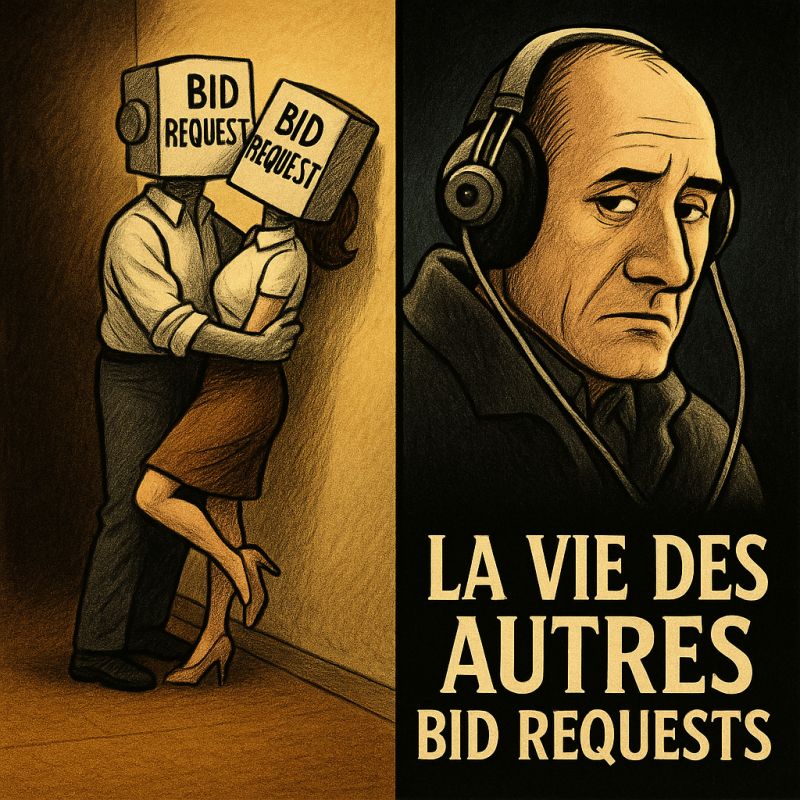
Just before the holidays, I was talking to a Media Trader when I noticed a puzzled look on his face. We had started discussing Bid Listeners. “Wait… what exactly is a Bid Listener?!”
1. The mysterious observer in the programmatic marketplace 🕵️
Imagine a huge marketplace where hundreds of merchants offer their advertising inventory for sale. That's the Open Web.
Now picture a slightly mysterious character wandering from stall to stall, discreetly listening to the merchants' offers.
He's there, but strangely enough… he never places a bid. 🤔 Instead, he takes notes. Lots of notes. A LOT of notes! 😮
No, this isn't a Cold War spy movie. You've just met a Bid Listener. 😉
2. What is a Bid Listener in programmatic advertising?
A Bid Listener is a technology or data-collection arrangement that receives and analyzes RTB bid requests, typically through an authorized integration with a DSP or another auction participant. It observes advertising opportunities without necessarily trying to purchase them.
Depending on the exchange, available integrations and privacy permissions, a bid request may expose some of the following signals:
| Signal category | Examples | Potential insight |
|---|---|---|
| Supply | Publisher domain, app, supply path | Where opportunities originate |
| Placement | Ad size, format, placement attributes | What inventory is being offered |
| Context | Page or content signals, where shared | Which environments appear in auctions |
| Device & geography | Device type, approximate location | Inventory composition |
| Identifiers | Permitted advertising IDs or transaction-related fields | Possible coverage and overlap analysis, subject to restrictions |
One important detail: a Bid Listener does not automatically receive every bid request on the internet. It only sees what its specific integrations, contracts, supply paths and filters make available.
3. How does a Bid Listener work?
In a simplified setup, the process can look like this:
- Establish an authorized data feed from the relevant DSP, SSP or auction infrastructure.
- Define the scope: countries, domains, publishers, formats and permitted data fields.
- Receive and process bid requests without necessarily submitting bids.
- Aggregate and analyze signals for approved use cases, with appropriate access controls and retention limits.
Some implementations deploy dedicated infrastructure close to auction systems to reduce latency. Others use existing DSP integrations or approved data feeds (the architecture depends on the provider and its contractual permissions).
The point isn't to build a secret window into every auction. It's to analyze the bid-request stream that a participant is authorized to access.
4. Four uses for Bid Listener data
Contextual intelligence and Brand Safety
Contextual and Brand Safety providers can use permitted URL or content signals to identify pages appearing in actual advertising opportunities. Their crawlers can then prioritize those pages rather than crawling the entire web indiscriminately.
That can make classification infrastructure more efficient (though a bid request alone does not establish whether a page is safe or suitable). For another way to audit filtering decisions, see our guide to Reverse Analytics in programmatic advertising.
Media planning and inventory intelligence
Aggregated bid-request volumes can help buyers understand the composition of available supply, compare formats and identify opportunities across participating publishers.
But beware: bid requests are not unique users, delivered impressions or guaranteed available inventory. Duplicate auction paths, throttling and eligibility rules can all affect what the numbers mean. Our explanation of programmatic throttling explores one part of that puzzle.
Identity graph analysis
Where the relevant data use is permitted, identity providers may study the presence and overlap of advertising identifiers across supply paths.
That makes transparency around identifiers and transaction data important. However, the mere presence of an identifier does not authorize its use for profiling or matching. Consent, privacy law, contractual restrictions and technical controls remain decisive. Related reading: the debate around the Transaction ID.
The original discussion also references this LinkedIn post about TIDs.
Historical lookalike audience modeling
Could auction-level observations have been used to enrich audience models at relatively low cost? Historically, that is a plausible scenario for some businesses combining trading and platform capabilities, particularly before the GDPR took effect.
But this is a hypothesis about possible past practices, not evidence against any named company. Today, reusing bid-request data for audience profiling raises serious privacy and contractual questions. If you're interested in audience modeling itself, read our piece on lookalike segment fragmentation.
5. What are the limits of a Bid Listener?
- Partial visibility: it sees only authorized bid-request flows, not the entire market.
- Sampling and filtering: technical restrictions may distort apparent supply volumes.
- No automatic proof of performance: a request is not a win, a viewable impression or a business outcome.
- Privacy and contractual boundaries: access to data does not mean unrestricted rights to retain, combine or resell it.
These distinctions matter when evaluating vendor claims. A large data stream can be useful—but only if its scope, permissions and methodology are clear.
6. How does GreyFox Ads access bid-request signals without a Bid Listener?
At GreyFox Ads, a French programmatic advertising company, we do not operate a separate Bid Listener.
Instead, we work through Curator platforms, using the bid-request signals and inventory controls available within our authorized curation environments. That helps us build one Master Curated Deal for agencies and Media Traders looking to activate quality French Open Web inventory.
- Supply Path Optimization: favoring direct publisher paths and resellers with genuine added value.
- MFA prevention: excluding Made-for-Advertising websites and subdomains.
- Brand Safety and ad fraud controls: reducing exposure to unsuitable or fraudulent inventory.
- Ad format quality: prioritizing meaningful screen share rather than viewability alone.
- Addressability: combining cookie-based and cookieless approaches where technically and legally appropriate.
- Fee transparency: making the programmatic cost chain easier to understand.
For more on the role of curation, see what Curators actually do.
7. The key takeaway
A Bid Listener isn't a bidding strategy. It's a way to observe and analyze authorized RTB bid-request streams—and learn more about inventory, context and supply paths.
What matters is not just how much data you can listen to. It's what you can reliably infer from it, and whether you have the right to use it. 🕵️
Original LinkedIn post: Read the original Bid Listener post.
Looking for a Programmatic Advertising Partner?
Need to activate high-quality French Open Web inventory without multiplying supply paths and operational complexity? Let's talk about the GreyFox Ads Master Deal.
Contact GreyFox AdsExplore the Master Deal