Why did Open Garden and GreyFox Ads investigate AI in French media buying?
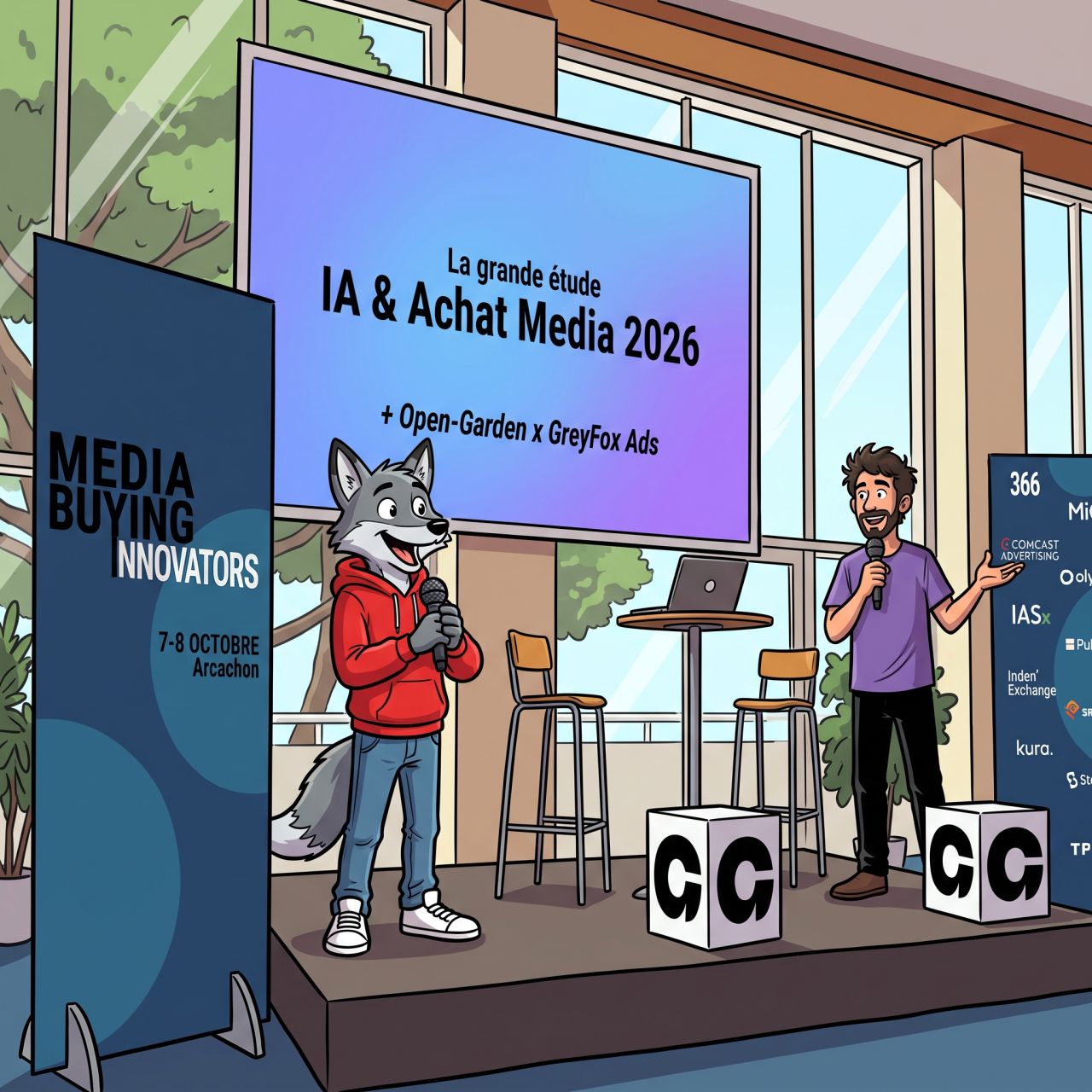
GreyFox Ads was on stage on Wednesday morning, 7 October 2026, at Media Buying Innovators in Arcachon, alongside Nicolas Jaimes, to unveil the first findings of the major “AI & Media Buying 2026” study. 🤩
It all started with a simple observation: everyone talks about AI in digital advertising... but what's actually happening in the French market? It's all rather unclear...
And that's when Nicolas had a brilliant idea: “What if we conducted a study to get a clearer picture?” 💡
Instead of another round of grand predictions about the agentic revolution, the idea was to ask professionals what they have genuinely tested, how they use it and where the difficulties lie. Open Garden's September 2026 invitation to take part confirms this practical focus.
What questions does the AI & Media Buying 2026 study seek to answer?
The aim was to tackle the questions many of us in AdTech have been asking:
| Research topic | Question posed to the industry |
|---|---|
| Adoption | How quickly is the market evolving when it comes to AI and agentic technologies? |
| Barriers | What are the main obstacles to adoption? |
| Use cases | At which stages of the media-buying value chain are teams testing AI most? |
| Results | Are those tests proving satisfactory or disappointing? |
| Autonomy | How much independence are organisations giving AI agents? |
| Reliability | What error rates are teams observing? |
| Competition | Which types of players are most likely to come out on top in the agentic race? |
| Jobs | What does all this mean for the future of digital media buying professions? |
And that's only the start of it... 😉
Here, agentic AI means software agents that can carry out a sequence of tasks — such as reading a brief, analysing data or preparing campaign actions — with varying levels of human supervision (not necessarily fully autonomous media buying).
Who contributed to the study, and what does “60+ respondents” mean?
The results? We finally had some initial answers to those questions thanks to more than 60 respondents working in:
- Media agencies and trading desks
- AdTech companies
- Programmatic media sales houses
- Consultancies
These were people who had got their hands dirty with AI and/or worked very closely on the subject, sharing first-hand experience with us. 💪
One important distinction: more than 60 industry responses can provide useful signals about experiences and perceptions, but they do not automatically make the sample representative of the whole French media-buying market (the public call for participation does not establish random sampling or a known statistical margin of error).
Open Garden also stated that responses would be anonymised, with no company names identified in the published findings. That was part of the original study invitation.
Why ask about AI agents' autonomy, error rates and real performance?
Because there's a big difference between “we've tested AI” and “AI reliably improves media buying”.
An AI assistant that drafts a report is not the same thing as an agent authorised to change a live campaign budget. Both may be useful, but they raise very different questions about supervision and responsibility.
The study's questions therefore matter to agencies and media buyers evaluating adoption, real-world results, error rates and the future of Media Trader roles. They do not by themselves establish whether AI has already delivered better performance or reduced staffing needs.
We have explored the same debate in our English articles on AI-washing in programmatic advertising and the potential future of Media Traders in an agentic industry.
Where can professionals follow the study and the Media Buying Innovators event?
A huge thank you once again to everyone who responded and helped us see things more clearly. 🙏
At the time of our presentation, we announced that the results would be shared with respondents and the wider public in the following days, so everyone could access them. ☺️
The study was introduced in Open Garden's call for participation. The Media Buying Innovators event recap published by 366 also confirms that the AI/media-buying study was presented in Arcachon on 7–8 October 2026.
For the original behind-the-scenes announcement, see our original LinkedIn post.
Publication note (English edition, 12 November 2026): We have not verified a public source containing the complete numerical results. This page therefore describes the study and its questions, rather than inventing percentages or conclusions.
How does GreyFox Ads support the French Open Web?
At GreyFox Ads, we're convinced that a high-quality French Open Web delivers real effectiveness for advertisers.
We offer two complementary services:
- To Media Traders: a Swiss Army knife Master_Deal_ID designed to solve A LOT of the programmatic ecosystem's problems 👑.
- To Programmatic Sales Houses: consulting assignments on programmatic and Curation 💡.
Sources and further reading
- Original GreyFox Ads post: AI & Media Buying 2026 presentation.
- Open Garden (8 September 2026): original study announcement and questionnaire scope.
- 366 (28 October 2026): Media Buying Innovators recap.
- Media Buying Innovators: event dates and location.
- GreyFox Ads: AI-washing and programmatic advertising.
- GreyFox Ads: could AI reshape the Media Trader profession?.