Social Publishing: A Lifeline or a Trojan Horse for Open Web Publishers?
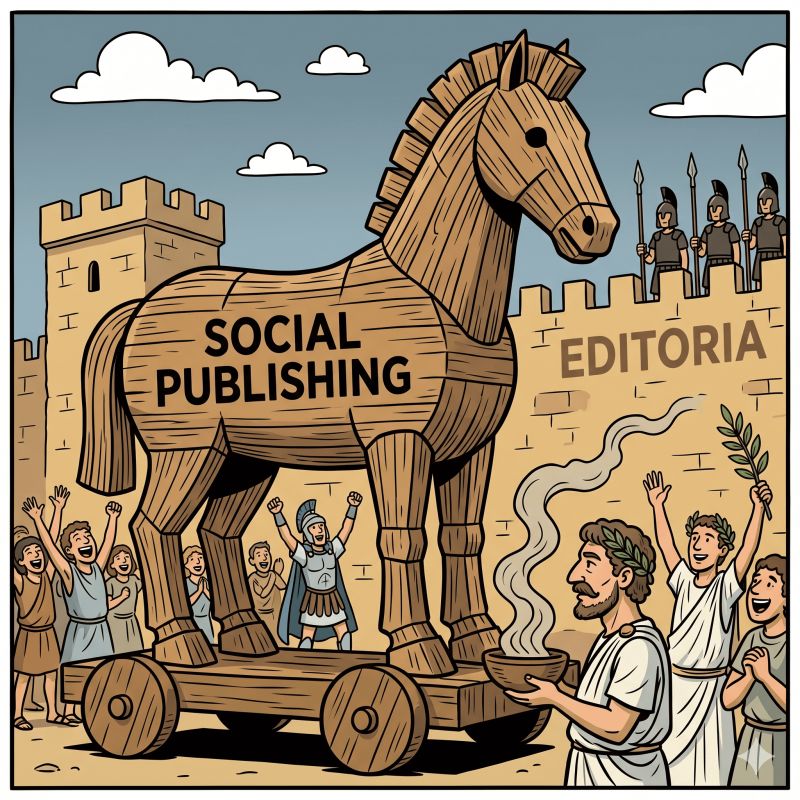
“Social publishing is giving us a bit of breathing room.” A publisher told me that recently. And I understand why: when advertising revenue on your own website is under pressure, sponsored posts and branded social videos can look like a welcome new source of income. But what if that lifeline is also a Trojan horse?
1. Why social publishing looks attractive right now
Here in France, the economic backdrop is hardly reassuring for news publishers. In the first half of 2025, social networks recorded roughly 15% growth while the “Publishing/News” segment saw advertising revenue fall by around 5%, according to figures cited in the original post from the French digital advertising market's SRI reporting (the categories and period matter; these figures should not be read as directly comparable revenue bases).
At the same time, publishers have spent years arguing with major platforms over the use and distribution of their journalism, including debates about neighboring rights in France. Their content helps animate social feeds, but the platform typically controls the user relationship and much of the monetization.
Against this backdrop, a publisher selling sponsored posts, stories or videos through its own accounts on Instagram, Facebook, YouTube, TikTok or X can unlock budgets that might never have been spent on its website.
2. The benefits of social publishing are real
There is a good reason commercial teams like the proposition. A trusted publisher brings editorial expertise and an established community; a social platform brings native formats and distribution at scale.
| Benefit | What it means for a publisher | What to measure |
|---|---|---|
| Additional reach | Reach people who may not visit the publisher's website regularly | Unique reach, frequency and overlap with owned audiences |
| Native creative formats | Use stories, short-form videos and other platform-native experiences | Completion, attention, engagement and brand outcomes |
| Publisher endorsement | Offer advertisers the credibility of an established media brand | Brand lift, quality of engagement and advertiser retention |
| New commercial budgets | Capture social or branded-content spend beyond traditional display | Incremental margin, not simply gross revenue |
But one question tends to disappear behind the sales pitch: who owns the distribution channel?
3. The Trojan horse: publishers are building on rented land
When an advertiser buys a campaign on a publisher's website, the publisher has substantial control over the editorial environment, the user experience and its monetization partners. With social publishing, a significant part of that control moves to the platform.
Algorithms determine who sees the content. Platform policies can change the reach of publisher accounts. Monetization conditions can evolve. Audience insights may be limited, and followers do not automatically become visitors to the publisher's own properties.
This creates a strategic paradox: publishers can earn more money from social publishing in the short term while becoming more dependent on the same platforms competing for advertising budgets and attention.
That does not make every social campaign a bad idea. It makes concentration risk a business issue, not just a marketing issue.
4. Remember Facebook's 2018 algorithm change?
In January 2018, Facebook announced changes to News Feed designed to prioritize meaningful interactions between people, rather than passive consumption of content from Pages. Publishers and brands experienced changes in organic distribution.
My original post referenced reports of an average 28% traffic decline and drops of up to 70% for some pages (these figures were drawn from a particular reported sample and should not be treated as a universal effect on all publishers).
The broader lesson remains relevant even without a single headline statistic: when a platform changes its rules, an audience you spent years building may suddenly become much harder to reach.
And unlike an algorithm you control, a platform algorithm offers no guarantee of tomorrow's distribution.
5. Five ways publishers can strengthen their own Open Web business
What if publishers invested just as much creativity in their owned-and-operated environments as they do in social formats?
Bring audiences back to the publisher's own properties
Build direct habits through distinctive journalism, newsletters, apps, communities and useful on-site features. Comments and social interactions can help when they are moderated and genuinely valuable (adding a comment box alone will not create a community).
Improve the advertising experience
Offer advertisers formats with meaningful screen presence and better attention potential, without overwhelming readers. For example, well-designed sticky or skippable formats may be worth testing, provided they respect user experience and relevant platform policies. Our article on mobile fullscreen advertising formats explores this trade-off.
Extend audience monetization through curation
Publishers with valuable first-party audiences can work with Curators to make relevant segments available across a broader selection of quality Open Web inventory, subject to lawful data use and activation capabilities. That creates a way to extend commercial reach without moving every campaign into a walled garden. See why publishers open Curator Seats and our guide to programmatic curation.
Set clear rules for AI crawling and licensing
Review which automated crawlers can access content, how licensing is negotiated and whether blocking specific bots is commercially sensible. Blocking all LLM crawlers without distinction is not a guaranteed revenue strategy (it can also affect discovery, and technical controls vary by bot).
Consider shared distribution, not just individual subscriptions
What if news publishers built a destination that readers wanted to open every day, with shared access and fair revenue distribution? Our proposal for a Spotify-style super app for the Open Web explores that idea. It is ambitious, but it addresses a structural issue: fragmented publisher experiences versus seamless platform ecosystems.
6. The better strategy is diversification, not social-media abstinence
I am not suggesting that publishers stop selling sponsored social campaigns. If advertisers want them, if the campaigns perform and if the economics work, there is no reason to ignore that demand.
But publishers should ask a few uncomfortable questions before making social publishing the centerpiece of their growth plan:
- How much revenue and margin depend on a small number of platforms?
- Can the publisher maintain a direct relationship with the audience reached?
- Does the social campaign generate genuinely additional revenue, or shift budgets away from owned inventory?
- What happens if organic reach or commercial terms change next quarter?
- Are investments in owned audiences, product and ad quality keeping pace?
Social publishing can be one leg of the table. It should not become the whole table.
7. Why GreyFox Ads champions a quality Open Web
At GreyFox Ads, we believe that a high-quality Open Web can deliver real efficiency for advertisers while supporting publishers that invest in content and user experience.
We are a human-sized French programmatic ad network. We help Media Traders outside France activate the French market through our Master Curated Deal, combining local publisher knowledge, quality controls, audience strategies and clearer supply paths.
Because the future of publishers should not depend entirely on someone else's feed.
Activate quality French Open Web inventory
Looking for a programmatic partner that understands French publishers and delivers transparent curated supply?
Discover the Master DealContact GreyFox AdsOriginal perspective: Read the original LinkedIn post. Historical figures are attributed to the author's original sources and have not been independently re-audited for this adaptation.