Mobile Interstitial Ads: Could Fullscreen Formats Help Save the Open Web?
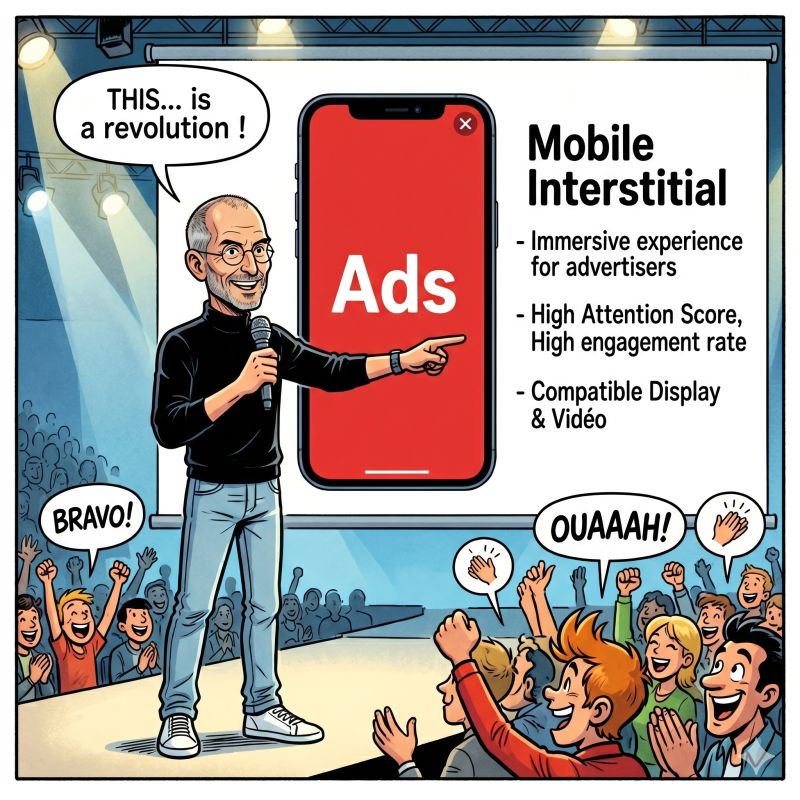
What if one of the formats publishers were encouraged to abandon could help them finance the free Open Web? I'm talking about the mobile interstitial: a fullscreen advertising experience that deserves a fresh debate.
What is a mobile interstitial ad?
A mobile interstitial is an ad that occupies most or all of a smartphone screen, typically appearing between two content experiences. Years ago, Media Traders could buy 320 × 480 mobile-web interstitials that supported display or video creative, sometimes with a skip option after five seconds.
For a brand, the appeal is obvious: a larger creative, a more immersive storytelling opportunity and the possibility of being noticed rather than disappearing into the page. Attention measurement companies such as xpln.ai and Adelaide have helped bring these questions to the forefront (although the format alone does not guarantee attention or effectiveness).
Why did mobile interstitials fall out of favour on the mobile web?
In 2017, Google began applying a mobile-search ranking signal to pages where content was not easily accessible because of intrusive interstitials. The broader Coalition for Better Ads also pushed the industry to reconsider disruptive ad experiences.
The important nuance: not every interstitial is automatically penalized. Google's search guidance distinguishes intrusive experiences from certain permitted or appropriately designed dialogs, and advertising policies can impose additional restrictions. A five-second skip button by itself does not establish compliance.
And yes, there's an irony worth pointing out: fullscreen video advertising remains commonplace on platforms such as YouTube. Different environments have different rules and expectations, but the contrast raises a legitimate question about how we value advertising experiences across the open and closed web. Do as I say, not as I do? 😉
Could fullscreen formats outperform standard mobile banners?
Many mobile-web publishers now rely heavily on conventional IAB banner placements. Those formats can work, but a small banner may occupy only a limited share of the screen and compete with the surrounding content.
| Consideration | Standard mobile banner | Skippable fullscreen interstitial |
|---|---|---|
| Creative space | Limited canvas | Large canvas for display or video storytelling |
| Attention potential | Depends on size, position and context | Potentially high, but not guaranteed |
| User experience | Usually less disruptive | Can interrupt content access if poorly designed |
| Publisher monetization | Established demand and pricing | Possible premium opportunity, subject to demand and policy constraints |
We've previously explored the Open Web's attention problem and explained why viewability alone is not a measure of real advertising effectiveness. A fullscreen format is an interesting hypothesis precisely because it invites us to look beyond the traditional viewability KPI.
Why should French publishers revisit this debate?
Here in France, premium publishers face pressure from large digital advertising platforms and evolving search experiences, including AI-generated answers that can reduce clicks to original content. The challenge is straightforward: how do you keep high-quality journalism and content freely accessible if the economics of advertising become harder?
In my original commentary, I cited an estimate that Google, Meta, social platforms and Amazon captured 74% of French digital advertising revenue, attributed to the SRI's Observatoire de l'e-pub (the exact scope and period should be checked against the relevant edition before reusing the figure as a current benchmark).
That is why I believe it is worth reopening the discussion around a carefully controlled, skippable mobile-web interstitial—not as a universal replacement for banners, but as a potential addition to the publisher's toolkit.
We've also discussed why creative size matters when comparing desktop and smartphone advertising, and why poor advertising experiences on MFA sites undermine the Open Web. A better monetization model must avoid repeating those mistakes.
How could publishers test fullscreen ads without sacrificing the user?
- Make content access the priority. Avoid blocking users from reaching the content they requested; review Google's current search and advertising policies before deployment.
- Provide an obvious, accessible dismissal control. A short countdown or skip mechanic should be tested against real usability outcomes, not assumed to make the format acceptable.
- Limit frequency. Repeated interruptions can destroy the value of an otherwise engaging format.
- Measure more than CPM. Track attention, brand outcomes, revenue per session, bounce rates and return visits.
- Run controlled experiments. Compare user experience and net publisher revenue against existing placements, with attention to mobile page performance.
The goal is not to bring back the most aggressive advertising practices of the past. It's to ask whether a better-designed, fairly priced, user-respectful fullscreen format could help fund quality content.
GreyFox Ads: a stronger French Open Web, not just more ads
At GreyFox Ads, we believe a quality French Open Web can deliver real advertising effectiveness. We may be the smallest ad network in France, but not the least competent.
Our Master Deals give Media Traders access to clean supply, smart targeting, simple activation and cost transparency. We also support publishers through our programmatic curation expertise.
And perhaps one day, the industry will agree that a thoughtfully designed fullscreen ad can be better for both the advertiser and the publisher than a page cluttered with a dozen tiny banners. That would be a welcome change.
Original commentary: Read the original LinkedIn post.
Want to activate high-quality programmatic campaigns in France?
Talk to GreyFox Ads about premium French Open Web inventory, curated Display and Video deals, and transparent buying paths.
Contact GreyFox AdsExplore the Master Deal