Can a Spotify-Style Super App Save the Open Web?
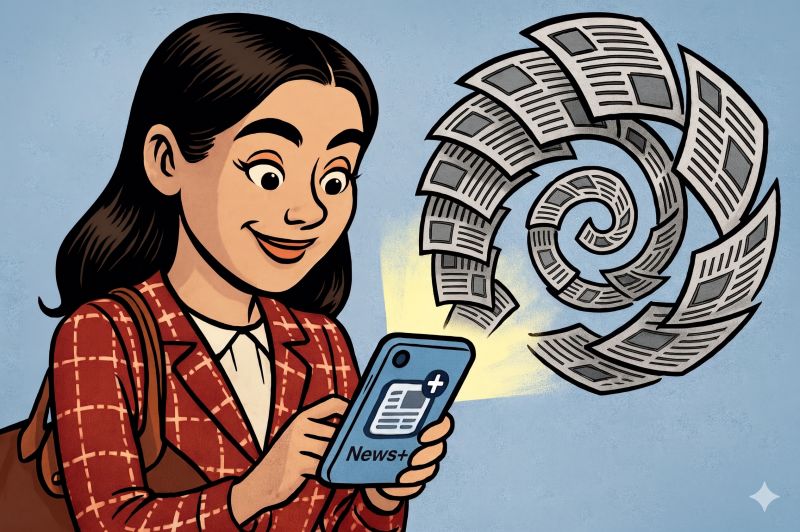
What if the future of independent journalism looked less like a collection of separate paywalls — and more like Spotify? Here in France, the Open Web needs a new way to make quality content convenient for readers and economically sustainable for publishers.
1. What the music industry can teach publishers
Remember the music industry's crisis? Illegal downloading made enormous catalogues available at little or no cost, while buying albums one by one felt increasingly inconvenient. Recorded-music revenues fell sharply in the 2000s, before streaming helped rebuild a market around convenient, licensed access (the exact decline and subsequent recovery depend on the geography, years and revenue series used).
Spotify and Deezer did not persuade listeners to subscribe separately to every record label. Instead, they offered one interface, a huge catalogue and a relatively affordable monthly subscription. Rights holders received a share of the revenues under licensing arrangements.
That is the interesting lesson: convenience and aggregation changed the value proposition. It was not simply a matter of charging users for content that used to be free.
In the original post, I highlighted figures of a 35% decline, a subsequent 110% increase and streaming representing 67% of industry revenue, citing Statista. Those figures illustrate the historical turnaround, but should not be treated as directly comparable without specifying their markets, periods and definitions.
2. Why the Open Web needs a new model
Independent publishers face several pressures at once. Large digital platforms capture a substantial share of advertising investment; AI-powered answers and zero-click search can reduce the incentive to visit the original website; and readers understandably resist paying for a dozen separate subscriptions.
For French publishers, the challenge is especially tangible: high-quality reporting is expensive, but access to readers is increasingly mediated by search engines, social networks and other platforms. The effect of AI on traffic varies by publisher and query type, so it is worth measuring rather than assuming a universal decline.
Meanwhile, the Open Web's attention problem and the fragmentation of its audiences make monetization harder. We cannot solve every problem with one more advertising optimization.
3. The publisher super app: how it could work
Imagine a single app where readers can discover and consume articles from a broad coalition of participating publishers. One account. One search bar. One recommendation experience. No need to remember which publication has which subscription.
Think about the alternative: what if Spotify asked you to buy a separate subscription for every record label — or every music genre? It would be absurd. Yet news readers routinely face something similar.
| For readers | For publishers | For advertisers |
|---|---|---|
| Convenient access to diverse reporting in one place | A shared discovery and distribution channel | A consistent premium content environment |
| Choice between subscription and a free, ad-supported tier | Revenue beyond individual-site subscriptions | Transparent, controlled advertising formats |
| Personalization with meaningful privacy controls | Potentially less dependence on external gatekeepers | Access to quality, contextual audiences |
Participation should be voluntary. Publishers would retain their brands, editorial independence and the ability to link readers back to their own websites.
4. How publishers could get paid
My starting point is simple: share subscription and advertising revenue according to the reading that publishers actually generate. Reading time is an intuitive signal, but not a perfect one (a long open tab is not the same as genuine attention).
A practical model could combine qualified reading time, completed reads and other validated engagement signals, with safeguards against bots, clickbait and gaming. The formula would need to be public, independently audited and agreed by participating publishers.
There is also a crucial question of bargaining power: smaller publishers must not be crowded out simply because the biggest brands already command the most attention. A transparent governance structure matters as much as the algorithm.
5. A better advertising experience for brands
Such an app could offer a more deliberate, premium advertising experience than the cluttered pages readers sometimes encounter today: carefully integrated sponsored articles, relevant contextual placements and mobile interstitials with clear controls.
For example, a skippable fullscreen format might create a memorable brand moment without making the entire experience miserable. But a “skip after five seconds” rule is not, by itself, a guarantee of good UX or compliance with search and platform policies. Frequency, timing, consent and accessibility still matter.
I have explored this idea in more detail in our article on fullscreen mobile formats and Open Web monetization.
For programmatic buyers, the opportunity would be quality inventory, clearer supply paths and better measurement — principles we also apply through GreyFox Ads' Master Deal.
6. What existing initiatives are missing
This is not a completely new idea. Here in France, services such as Cafeyn already demonstrate that readers can be interested in a single subscription covering multiple publications.
But my proposal goes further: a truly publisher-backed destination designed around individual web articles, an optional free ad-supported experience and active cross-promotion by participating media brands. Existing services differ in catalogue, presentation, licensing and business model; it would be inaccurate to suggest they all offer only PDF editions.
The key differentiator would not be the app itself. It would be publishers collectively choosing to build and promote a distribution channel they help govern.
7. The hard questions nobody should ignore
There are real obstacles: who funds the product, who controls recommendations, how are revenues allocated, what happens to subscriber relationships and how do we protect editorial diversity?
Data protection is another central issue. A shared reading app would need clear user consent choices, privacy-by-design measurement and strict limits on the reuse of behavioral information. A publisher-owned platform should not reproduce the most problematic practices of the platforms it aims to challenge.
Finally, the economics need testing. A subscription or ad-supported super app could complement direct publisher traffic and subscriptions, but it could also cannibalize them. The right question is whether it creates incremental audience and revenue after all costs — not merely whether the app becomes popular.
8. A collective bet on the Open Web
Fifteen years ago, music listeners did not need another lecture about copyright. They needed a product that made legal listening easier than piracy.
Perhaps news readers do not need another dozen paywalls. Perhaps they need one compelling place to discover quality journalism — with a business model that rewards the publishers creating it.
Could a Spotify-style super app save the Open Web? Not on its own. But if publishers want to reclaim their relationship with audiences, building a shared destination might be more ambitious — and more promising — than waiting for platforms to send the traffic back.
Original discussion: Read Max Legrand's original LinkedIn post.
Activate the quality French Open Web
GreyFox Ads helps international Media Traders reach French audiences through one curated Master Deal, combining local market expertise, quality inventory and transparent activation.
Explore the Master DealContact GreyFox Ads