What did Apple actually block in 2026?
It's THE big news of the weekend: Apple's blocking of The Trade Desk was apparently... no mistake! 😱
Or, more precisely, there were two different things going on — and separating them makes the story even more interesting.
- A deliberate privacy policy: in September 2026, Apple began blocking network access to certain identity-resolution infrastructure in Safari/WebKit. On 19 October 2026, its WebKit team confirmed that the purpose was to prevent covert cross-site identification using data such as email addresses. Apple's own explanation.
- An ad-serving block described as unintended: The Trade Desk's ad-delivery domain was also caught up in the initial restrictions. Subsequent reporting described that particular block as inadvertent and said it was reversed, whereas restrictions on identity-resolution providers continued (Digiday, 20 October 2026).
So the wider move against post-cookie tracking was intentional; the initial interruption of The Trade Desk's ad-serving function should not be presented as proof that Apple deliberately intended to stop all its ads.
But the episode is still the tip of a much bigger iceberg in the battle over online privacy 👉 the original link we shared.
And it reminds us that the digital advertising ecosystem lives every day with a sword of Damocles hanging over its head...
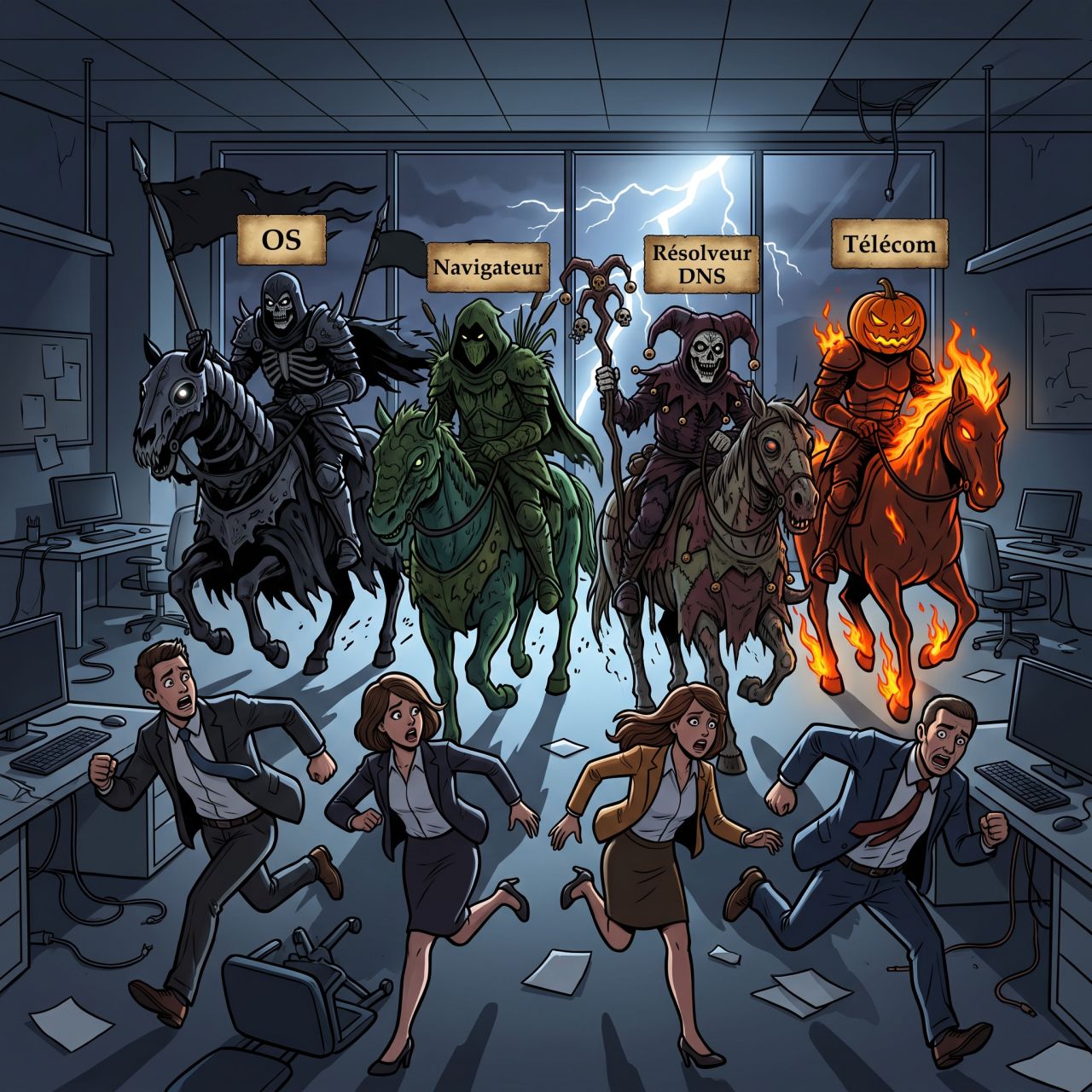
⚔️⚔️ The Four Horsemen of the ADpocalypse ⚔️⚔️ 😱😱😱
With a snap of their fingers, they can bring the advertising ecosystem to a standstill 🤯 (at least for the affected traffic, products or integrations — not necessarily the whole internet).
Which four layers can block or restrict programmatic advertising?
Each horseman rules a different part of the same journey: from device permissions to browser requests, domain resolution and network delivery. Their powers are not interchangeable.
| The horseman | What it controls | Possible impact on AdTech |
|---|---|---|
| ⚔️👑 Operating system | Device permissions, app-level APIs and browser-engine rules. | Restrictions on app tracking, identifiers or integrations. |
| ⚔️🌐 Browser | Cookies, web storage, network requests and tracking prevention. | Reduced addressability, blocked requests, lower measurement continuity. |
| ⚔️💬 DNS resolver | How domain names are resolved into IP addresses. | Blocking ad/measurement domains or making endpoints unreachable. |
| ⚔️📶 Telecoms operator / ISP | Network connectivity and traffic transport. | Outages, network restrictions or legally mandated blocking (subject to net-neutrality obligations). |
This is an explanatory comparison, not a claim that all four actors have the same legal powers or that every restriction is unjustified.
1. The operating system: the king of the kingdom ⚔️👑
Whatever device you use, there is no greater ruler in these lands than the operating system (OS). And in our little medieval fable, there are two kinds of kings:
- ⛓️💥 The merciful king: one who grants his subjects a little autonomy. Take Android, which generally gives third-party browsers greater freedom over their browser engines (although choices remain subject to platform and security rules).
- 🔗 The tyrannical king: one who keeps the court under pressure. Take iOS, whose historically tight integration with WebKit has allowed Apple to enforce browser-engine tracking restrictions across many third-party browsers (the applicable rules also depend on region and browser-engine entitlements).
Kings can also decide to restrict tracking across ALL apps 😱 — as Apple's App Tracking Transparency (ATT) demonstrates for covered tracking use cases.
These are choices with very real consequences for targeting, identity and campaign measurement. But user privacy protections should be assessed on their own merits; their effects on AdTech do not, by themselves, make them illegitimate.
2. The browser: the gatekeeper of the Open Web ⚔️🌐
A browser is an app on steroids. Its owner can introduce new rules whenever it pleases — sometimes in a software update that buyers and publishers learn about only afterwards.
A browser can affect AdTech in at least two ways:
- Blocking cookies or identifiers: Safari's Intelligent Tracking Prevention (ITP) and other privacy restrictions can limit cross-site recognition and measurement. See the WebKit Tracking Prevention Policy.
- Blocking advertising-related requests: browsers such as Brave offer built-in content blocking; Safari's 2026 restrictions on selected identity-resolution domains show that a browser can also prevent specific network connections (and initially affected The Trade Desk's ad delivery on some iOS 27 devices).
The practical consequence is that an impression that looked addressable in a DSP or SSP may become difficult to identify, target or measure in the browser. That is one reason why cookieless inventory requires different buying strategies — not simply another identifier.
3. The DNS resolver: the power to make domains disappear ⚔️💬
DNS (Domain Name System) is what connects a human-readable domain name to its IP address. Think of the resolver as the kingdom's address book.
Some well-known services and tools include Cloudflare, Pi-hole and AdGuard DNS, but they do not all behave alike. Cloudflare's standard 1.1.1.1 resolver, for example, does not block advertising by default, whereas purpose-built filters can block selected ad or tracking domains.
An overly broad blocklist — or a simple configuration error — can prevent calls to an ad server, measurement vendor or identity endpoint from resolving.
🚫 Domain not resolved = request not completed. No sophisticated auction algorithm can buy an impression if a necessary connection never happens.
4. The telecoms operator: the army's logistics specialist ⚔️📶
The group's logistics specialist is responsible for carrying all the data. An internet service provider (ISP) can affect delivery through its network, although its freedom to restrict traffic is very different from a browser's or an OS vendor's.
In France, the 2013 Free–Google/YouTube dispute illustrates the tension. Free briefly activated an ad-blocking feature on Freebox equipment as tensions over the delivery of Google/YouTube traffic escalated. The blocking initiative and the underlying interconnection dispute were related, but not the same technical mechanism. France's regulator, Arcep, documented the controversy in January 2013.
Today, EU rules on open internet access limit discriminatory blocking and throttling by ISPs. The rules allow narrow exceptions, including compliance with legal obligations, network integrity and exceptional congestion management (European Commission).
Telecoms operators may also be required to implement court-ordered technical blocks, for example against certain piracy-related services. In other words, this horseman can act — but not as an unconstrained ruler.
What happens when one of these gatekeepers changes the rules?
The issue is not merely a blocked pixel. A change at one layer can cascade through the Open Web:
- For publishers: fewer eligible ad requests, weaker identity signals or lost demand may reduce the ability to monetise particular audiences.
- For Media Traders: audience matching, frequency capping and attribution can become less consistent across environments.
- For technology providers: dependencies on a particular operating system, browser engine, DNS service or network can turn into sudden operational risk.
- For advertisers: campaign reach and measurement may change even though their DSP settings remain identical.
These mechanisms are not all equivalent to censorship or an outright advertising ban. Sometimes the change protects a legitimate user preference; sometimes its implementation catches unintended services. The important point is how exposed the supply chain is to a handful of infrastructure gatekeepers.
How can the Open Web become less vulnerable?
When AdTech clashes with one of the four horsemen, it may have to seek legal or regulatory remedies — and disputes can last years before a ruling arrives. 😮💨
But a court case is not the only response. A more resilient ecosystem can act earlier:
- Reduce unnecessary dependencies: understand which domains, browser APIs and ad-delivery endpoints are critical for each campaign.
- Design for privacy-first environments: use contextual relevance, valid consent and publisher first-party signals where appropriate, rather than assuming cross-site identity will always exist.
- Measure by environment: monitor reach, delivery, win rates and measurement gaps across Safari, Chrome, Android, iOS and no-consent inventory.
- Keep the supply path transparent: favour clear, auditable SSP and DSP integrations rather than unnecessary layers of intermediation.
- Engage with open standards and regulators: document unintended breakage, participate in technical discussions and use appropriate legal recourse when needed — without circumventing users' privacy choices.
These are practical responses, not a promise that the Open Web can become fully independent from the devices and networks on which it runs.
We have explored related risks in our analyses of the audience attrition chain and the growing DSP–SSP war.
What is GreyFox Ads' position on the French Open Web?
At GreyFox Ads, we're convinced that a high-quality French Open Web delivers real effectiveness for advertisers.
We offer two complementary services:
- To Media Traders: a Swiss Army knife Master_Deal_ID designed to solve A LOT of the programmatic ecosystem's problems 👑.
- To Programmatic Sales Houses: consulting assignments on programmatic and Curation 💡.
Our goal: make quality programmatic activation simpler, more effective and more transparent — even when the four horsemen start rattling their swords. ⚔️
Sources and further reading
- Original GreyFox Ads LinkedIn post — the four-horsemen metaphor and the original analysis.
- Original link accompanying the Apple–The Trade Desk news.
- WebKit (19 October 2026): Blocking Identity Resolution Infrastructure — Apple's stated policy.
- Digiday (20 October 2026): Apple explains the Safari block — including the accidental ad-serving block.
- AdExchanger (29 September 2026): The Trade Desk delivery issue.
- WebKit Tracking Prevention Policy.
- Cloudflare: Public DNS resolver policy.
- Arcep: Freebox ad-blocking controversy (January 2013).
- European Commission: Open internet access and net neutrality.
Editorial note: this page preserves the author's provocative ADpocalypse analogy. The factual clarifications distinguish Apple's intentional identity-resolution policy from the reported accidental interruption of The Trade Desk's ad-delivery domain; they also distinguish the 2013 Freebox ad-blocking incident from the Free–Google interconnection dispute. The original post's publication date was not provided, so the date above refers to this English edition's update.