Why is the audience attrition chain a business problem for publishers and retailers?
[An article by GreyFox Ads for Open Garden]
While the entire advertising market is obsessed with “CTV” and “AI”, there are plenty of other issues that deserve the spotlight 💡
Including one that many digital sales houses face... the audience attrition chain!
Take a publisher or retailer. There are often (very) significant gaps between:
- The audiences visiting its website.
- And the audiences that can actually be addressed through programmatic tools.
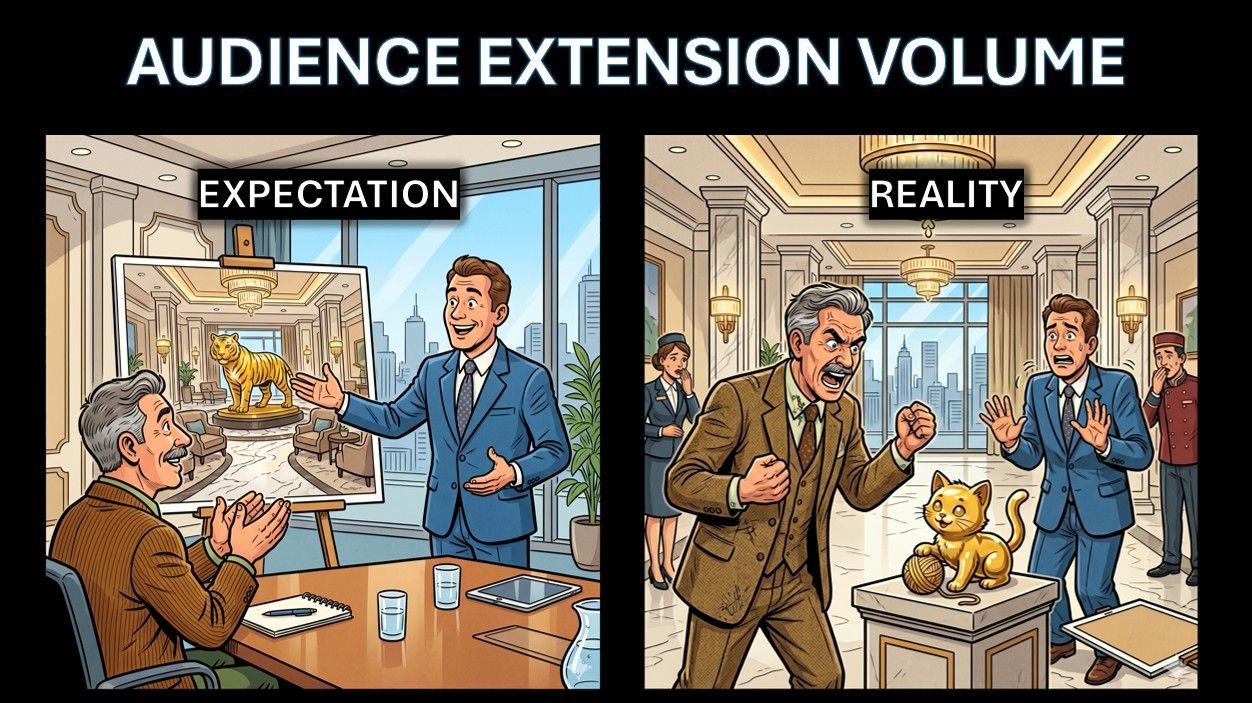
Think we're talking about a marginal difference? 🤷
Well, these gaps can reach as much as... 75%! 🤯
That's a huge amount of potential business going up in smoke 🔥💸
Why does this matter? A retailer may want to use its first-party data to reach customers beyond its own site, while a publisher may want to package audience extension for advertisers. In both cases, the number of website visitors is not the same as the number of people that can be matched and activated later in a DSP.
But why? Well, there's actually a whole “attrition chain” affecting audience addressability 🔗📉😱
What does “up to 75% of an audience may be unaddressable” mean?
For a publisher or retailer, site audience and programmatically activatable audience are not interchangeable. To compare them fairly, you need to define the same audience, period, scope and measurement unit.
| Illustrative indicator | Value | What it tells us |
|---|---|---|
| Eligible website visitors | 100,000 | Starting audience for a defined measurement period |
| Matched and activatable for audience extension | 25,000 | Audience that can be recognised and activated under applicable permissions |
| Addressability gap | 75% | 75,000 out of the 100,000 users cannot be activated in this hypothetical setup |
Illustrative example only: these are not measured GreyFox Ads results or market-wide benchmarks. The figure of up to 75% is discussed in the original Open Garden feature; any real calculation depends on data quality, identifiers, user choices and the activation platform. A user not addressable for cross-site audience extension can still encounter other forms of advertising, including contextual ads.
What are the five links of programmatic audience attrition?
In our full Open Garden analysis, we unpack the chain to: 🔍 identify its different links and ✅ propose concrete solutions at every stage.
| Link in the chain | Why audiences drop out | What to investigate |
|---|---|---|
| 1. Non-human traffic 🤖 | Visits from robots can inflate an analytics audience without representing genuine prospective customers. | Check traffic quality and upstream bot filtering. |
| 2. Consent and user choice 🔐 | Not every visitor authorises the tracking needed for cross-site audience activation. | Analyse valid, purpose-specific consent and respect refusals. |
| 3. Browser anti-tracking 🧭 | Third-party-cookie restrictions can prevent familiar cross-site matching methods. | Assess permitted first-party and alternative-ID integrations, including Safari. |
| 4. DMP tracking and data collection 🧩 | Misfiring or incomplete tags can reduce the pool recorded by the data management platform (DMP). | Audit consent-dependent tag firing, site coverage and segment population. |
| 5. DMP–DSP matching 🔄 | Some otherwise eligible audience records do not match or synchronise with the buyer’s DSP. | Compare matching performance across integrations or DSPs. |
These are condensed explanations of the five links discussed by GreyFox Ads in Open Garden, not a new independent study. The links do not represent five universal, additive percentage losses; they may overlap. Alternative identifiers are not a workaround for user consent or privacy requirements.
For a related view of this fragmented market, explore our analysis of the three faces of the Open Web, and why French publishers are revisiting consent walls.
Where can you read the full GreyFox Ads analysis in Open Garden?
We explore this chain in our original article for Open Garden, a leading French publication covering programmatic advertising, published on 15 September 2026. It explains each technical link and discusses practical ways to reduce avoidable losses.
🙏 Thanks to Nicolas JAIMES for letting us share our perspective in Open Garden, France's leading programmatic publication 🤩
What should a publisher or retailer measure before trying to recover lost audiences?
Before investing in yet another AdTech solution, it is worth diagnosing where audience records disappear. A practical starting point (an editorial checklist based on the Open Garden analysis):
- Define the denominator: are you counting sessions, genuine unique visitors, consented users or identifiers?
- Segment the gaps: compare browser, device, consent status and source of traffic without combining unlike populations.
- Audit the technical chain: bot filtering, tracking tags, authorised identity signals, DMP collection and DSP matching.
- Fix the largest avoidable loss first: verify the improvement using the same audience, period and measurement definitions.
Important: more addressability is not automatically better if it relies on overriding people's privacy choices. The goal is to improve lawful, high-quality audience activation, not track everyone at any cost.
And as zero-click search affects how publishers attract visitors, improving the quality of the audience that can legitimately be activated becomes even more important.