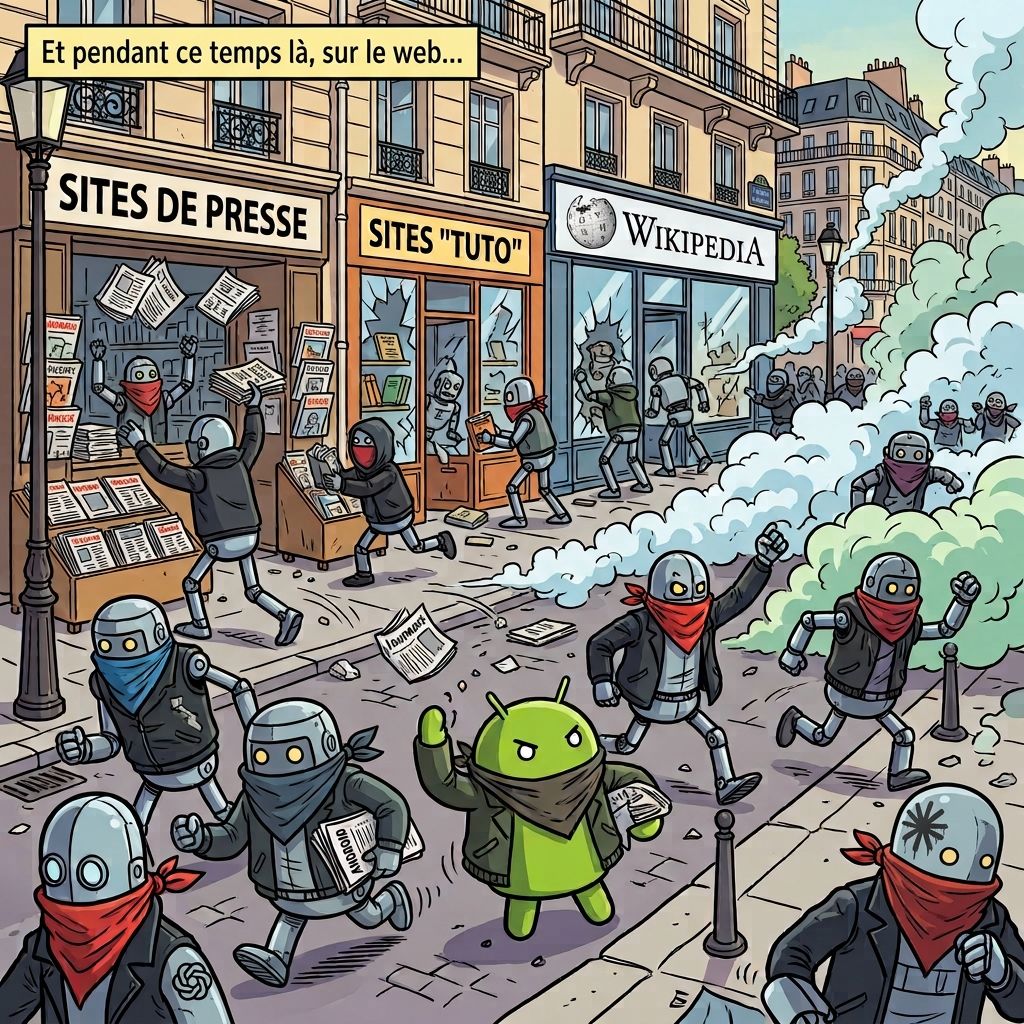
Following the demonstrations on 17 October 2026, France found itself in the world's spotlight because of the distressing scenes of violence that swept across the country… 😔 (contemporary coverage in Le Monde).
And we noticed that, following those scenes—replayed endlessly on TV news and social media—one keyword saw its search interest explode: “LOOTING”.
📈 +5,000% in searches/topics on Google Trends! 😮
(This is the Google Trends observation made for the original post; the exact keyword configuration, region and comparison period were not supplied, so the percentage should not be read as a verified count of searches.)
To borrow a line from Paris Match: “The weight of the images, the shock of the words/search queries.”
And speaking of looting, there's another kind that gets far less media attention—perhaps because there aren't any equally shocking images directly associated with it—but raises just as many questions.
It's THE GREAT AI LOOTING 🤖🔥
Why is generative AI such an attractive proposition for users?
As a user, you have to admit that AI offers an incredible value proposition:
- 💪 An assistant on steroids
- ⚡ That responds at lightning speed
- 🎯 To very specific questions
- 💵 For free (or a modest fee)
- ☺️ And never complains!
What more could you ask for?!
There's no point pretending that this experience isn't a breakthrough for users. The problem isn't that the answer is useful. It's the commercial relationship between the answer and the people who did the original work.
Why do AI answers create an economic problem for news publishers?
Well, the only slight problem is that the publishers whose content serves as the source for these answers:
- 😮 Aren't necessarily cited. Some AI responses identify their sources, but citation visibility varies by product and context.
- 😤 Are rarely paid—or are sometimes paid very little. Some licensing agreements exist, but many publishers do not have one and the commercial terms of deals are often confidential.
- 😡 See their traffic decline because of Zero Click Search. Our original article referred to declines of 15% to 50% according to different studies (these figures should not be combined into a single market average or attributed entirely to AI).
Zero-click search means that users obtain the information they need without visiting the website that originally provided it. It long predates generative AI, but AI-generated search summaries and conversational answers can make that behaviour more widespread. See our explainer on Zero Click Search and AI Overviews.
So publishers are watching their revenue… go up in smoke 🔥💸 (not every missing click would have generated revenue, and outcomes differ between publishers).
How much traffic is actually being lost to zero-click search and AI?
The answer depends on what is being measured. A fall in referral traffic, a difference in click-through behaviour and a publisher's forecast are three different indicators.
| Source / measure | Finding | What it does—and doesn't—show |
|---|---|---|
| Pew Research Center (2025) | 8% of visits to Google results with an AI summary led to a traditional result click, versus 15% without one. | Observed US browsing behaviour; not an estimate of publisher revenue loss or proof of causation. |
| Reuters Institute / Chartbeat (2026) | Google organic search referrals to more than 2,500 sites were down about 33% globally from Nov 2024 to Nov 2025. | A measured referral decline; the report cautions that AI alone cannot be isolated as the cause. |
| UK Association of Online Publishers (2026) | Google organic referrals fell 7.1% between Q1 and Q2 2025 across eight participating publishing groups. | A defined UK sample and period, not a French industry-wide average. |
Our original −15% to −50% range reflects estimates cited in the initial commentary, without specified source methodologies. The independent findings above are included for context; they are not a validation of every number in that range.
What happens to journalism if publishers receive only the crumbs?
Faced with declining revenue, publishers may be forced to cut costs. And a major cost for newsrooms is… writers' and journalists' salaries 😢
That raises a pretty fundamental question about the future of the web:
“How can we continue to get quality information if we only give the sources the crumbs?” 🤔
Investigations, interviews, verification and original reporting cost money. If too little value returns to those who do that work, publishers may have less room to finance it. This is a genuine business-model risk, not a numerical prediction of newsroom job losses.
And it's particularly relevant here in France, where publishers are trying to defend journalism while competing for both readers' attention and advertising budgets on an increasingly fragmented Open Web.
What can news publishers learn from the music and film industries?
In the early 2000s, the film and music industries faced a rather similar dilemma: their sales collapsed as piracy devalued the commercial distribution of content. 🏴☠️
What helped them recover was a combination of two very different responses:
- 🛜 Completely rethinking the model: goodbye CDs and DVDs as the dominant means of distribution; hello legal, centralised streaming services and new licensing arrangements.
- 👨⚖️ Pursuing long, costly legal battles: enforcement actions eventually took down several major piracy services.
The analogy is useful for thinking about how content gains value, not a claim that every AI use of published information is piracy. Copyright, permitted text-and-data mining, licensing and the treatment of facts are legally distinct (the EU Copyright in the Digital Single Market Directive includes provisions on press publishers' rights and text-and-data mining).
Perhaps the Open Web could take inspiration from what worked for others?
How could publishers regain value when AI answers replace visits?
A fairer answer economy will probably need more than one lever. Three are worth exploring:
- 🤝 Licensing and negotiated partnerships: make the value of original editorial content visible in commercial agreements, while recognising that not every publisher has the same negotiating leverage.
- 🔎 Clearer attribution and meaningful referrals: design AI experiences that help readers identify, trust and visit the original source when they want the full reporting.
- 🏠 Stronger direct audience relationships: build loyalty, newsletters, subscriptions and useful products that readers choose to visit directly. The debate about Login Walls is part of that shift (with user-experience and data protection trade-offs).
Some licensing deals have already been announced, but that does not mean the economic problem is solved (Reuters Institute, 2026).
For an Open Web supported by quality journalism, advertising also needs to create meaningful value for publishers instead of merely shifting budgets towards intermediaries. That concern runs through our analysis of AI-washing and the future of programmatic advertising.
What do you think? Should the Open Web take the music industry's path: new commercial models, more assertive negotiations and legal action where justified? Or is a different arrangement needed for the age of generative AI? 🤔
Sources and further reading
- Original GreyFox Ads LinkedIn post — the looting nobody talks about
- Original French article — IA et presse : le risque économique du Zero Click Search
- Le Monde — France's demonstrations and violence on 17 October 2026
- Pew Research Center — Search clicks when AI Overviews appear (2025)
- Reuters Institute — Journalism, Media and Technology Trends (2026)
- Association of Online Publishers — Publisher referral study (September 2026)
- EU Directive 2019/790 — Copyright, press publishers and text-and-data mining
Editorial note: “AI looting” is GreyFox Ads' provocative metaphor and commentary, not a legal verdict. The original Google Trends observation and broad traffic-decline range are retained as author-provided claims with limits. The cited studies refer to different geographies and measurement periods and do not establish that all referral losses are caused by AI.