Programmatic: WTF Is ads.txt? A Guide to Authorized Digital Sellers
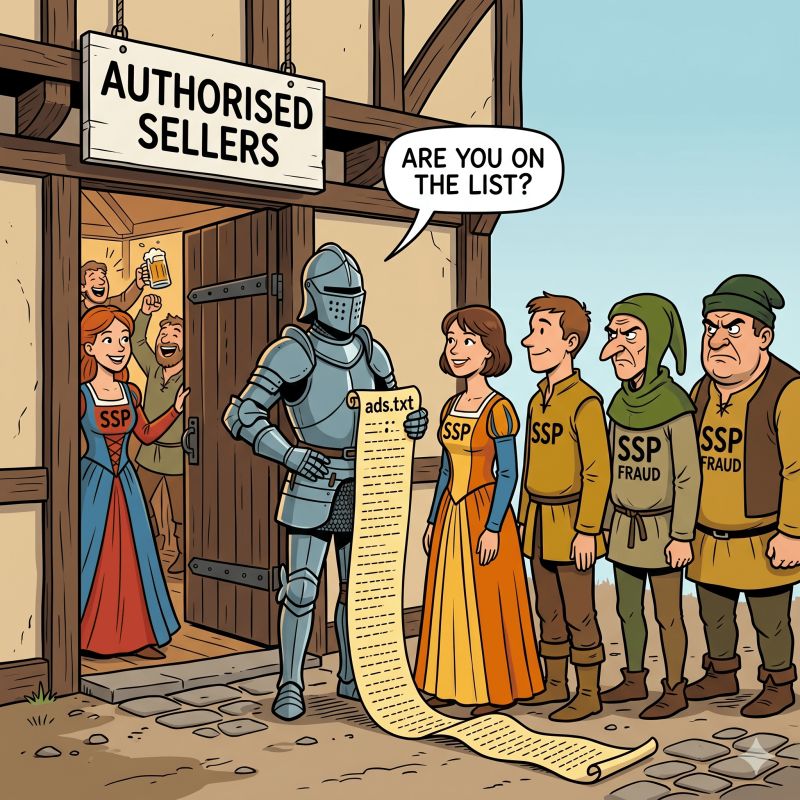
A group of French Media Traders recently told me: “We hear about ads.txt all the time, but it's still a bit blurry.” Fair enough. It looks like a boring text file, but it addresses one of the Open Web's biggest questions: who is actually authorized to sell a publisher's advertising inventory?
1. Rewind: the Methbot scandal and domain spoofing
About a decade ago, programmatic advertising faced a major trust problem. The Methbot operation became notorious for generating fraudulent video ad impressions while impersonating premium publisher inventory. Advertisers believed they were buying exposure on recognizable media properties; in reality, much of that apparent supply was fabricated.
Contemporary reporting discussed potential losses running into millions of dollars per day and estimates of more than $180 million on an annualized basis (these were estimates of the operation's scale, not a universally verified final loss figure).
The broader problem was straightforward: a domain appearing in an ad request did not necessarily prove that the seller had permission to sell that publisher's inventory. The industry needed a public way to check seller authorization.
2. What is ads.txt, exactly?
The IAB Tech Lab introduced ads.txt, short for Authorized Digital Sellers, to let website publishers publish an authoritative list of the advertising systems and seller accounts permitted to sell their inventory.
The file usually lives at the root of a publisher's domain. For example, try lemonde.fr/ads.txt. It's plain text: no login, no dashboard, no mystery. Just a list that buyers and verification systems can retrieve.
A DSP or intermediary can compare information from a bid request and the supply chain against the publisher's ads.txt declarations. An undeclared or mismatched seller relationship can be treated as unauthorized under the buyer's validation policy (actual filtering depends on implementation, inventory type and buying settings).
3. How to read an ads.txt line
A typical record contains four comma-separated fields:
| Field | Meaning |
|---|---|
| Advertising system domain | The platform operating the seller account, such as an SSP's domain. |
| Publisher / seller account ID | The account identifier within that advertising system. |
| Relationship | DIRECT or RESELLER. |
| Certification authority ID | An optional identifier, often a TAG ID, where applicable. |
Illustrative syntax (not a real authorization): example-ssp.com, 12345, DIRECT.
Notice what is not in the file: proof that every impression is viewable, human, brand-safe or genuinely valuable. Ads.txt is a seller-authorization signal, not an all-purpose quality certificate.
4. DIRECT vs RESELLER: the distinction that matters
This is where the discussion becomes particularly interesting for Media Traders.
| Declaration | What it indicates | What it does not automatically mean |
|---|---|---|
| DIRECT | The publisher has a direct business relationship with the advertising system for the account listed. | That the publisher technically owns every seat, or that no service provider is involved. |
| RESELLER | The publisher authorizes another entity to resell inventory through the account listed. | That the supply is fraudulent or necessarily low quality. |
The distinction is about the commercial relationship represented by that seller account, not a simplistic “good inventory versus bad inventory” classification.
In practice, buyers often prefer short, transparent paths. This can create pressure to label relationships DIRECT even where the underlying contractual arrangement does not justify it. That is why declarations should be accurate, and why the label should be checked against the broader supply chain rather than accepted blindly.
5. Why ads.txt is central to Supply Path Optimization
Ads.txt started as a defense against unauthorized selling and domain spoofing. It is also useful for Supply Path Optimization (SPO): deciding which intermediaries are worth buying through.
Imagine the same publisher inventory being offered through several SSPs and reseller accounts. An ads.txt file helps identify which paths are authorized; it does not tell you which one offers the best auction dynamics, lowest fees or highest performance.
For that, buyers should combine ads.txt with sellers.json, the OpenRTB SupplyChain object (schain), publisher relationships and campaign performance. This is exactly the question explored in our article on why so many bid requests come from resellers.
And if you're wondering why the same impression can still appear through multiple supply routes, read our breakdown of the Transaction ID debate.
6. What ads.txt cannot guarantee
Let's be clear: an authorized seller can still offer poorly performing inventory. An ads.txt-compliant bid request is not automatically a high-quality impression.
Ads.txt does not, on its own, validate ad attention, detect every form of invalid traffic, disclose all intermediary fees or eliminate auction duplication. Nor does a RESELLER label automatically mean that a route should be blocked.
Publishers also need to keep their declarations current and consistent. A stale seller ID, a missing account or an incorrect relationship label can cause legitimate supply to be misclassified.
For a related operational perspective, see how throttling affects programmatic bid requests.
7. A practical ads.txt checklist for Media Traders
When auditing a French publisher or an Open Web deal, I recommend a simple sequence:
- Open the publisher's ads.txt file. Check that it exists and can be fetched.
- Find the advertising system and seller account. Match the account identifiers to the supply path you are buying.
- Read the relationship label carefully.
DIRECTandRESELLERhave specific meanings. - Cross-check sellers.json and schain. An ads.txt line alone cannot describe the full chain.
- Compare actual results. Review fees where available, duplication, attention, viewability and business outcomes.
The objective is not to boycott every reseller. It is to avoid unnecessary opacity and make sure each intermediary has a defensible role in the transaction.
8. The takeaway: a tiny file, a big transparency issue
Ads.txt may be one of the least glamorous innovations in AdTech. Yet its basic idea is powerful: publishers publicly state who is allowed to sell their inventory, and buyers can verify that declaration.
Here in France, as elsewhere, that is an essential starting point for a healthier Open Web. But authorization is only step one. The next challenge is choosing the most direct, transparent and effective path to quality inventory.
At GreyFox Ads, we believe that buying better should be simpler — not more opaque. That's why we help international Media Traders activate quality French Open Web inventory through one curated Master Deal.
Original discussion: Read Max Legrand's original LinkedIn post.
Activate the quality French Open Web
GreyFox Ads helps international Media Traders reach French audiences through one curated Master Deal, combining local market expertise, quality inventory and transparent activation.
Explore the Master Deal Contact GreyFox Ads