Why Are Consent Walls Gaining Ground Among French Publishers? 🧱
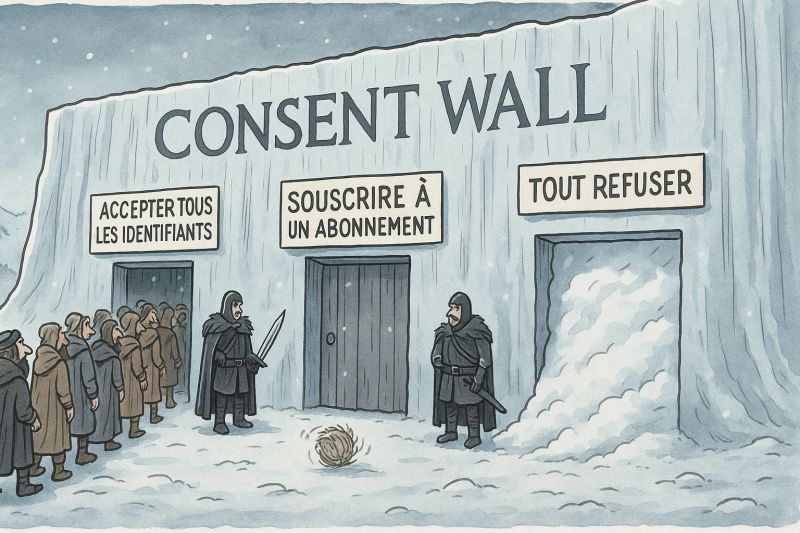
Why are more French publishers experimenting with consent walls? Behind the cookie banner lies a difficult equation: respect users' privacy choices while financing journalism, services and the advertising-funded Open Web.
1. Why does a lack of advertising consent affect publishers' revenue?
For years, many visitors to French news and content websites could simply choose between “Accept all” and “Reject all” for advertising cookies and other trackers. From the user's perspective, that's an important choice. From an ad-funded publisher's perspective, it can also change the economics of every page view.
A Didomi figure cited in our original French discussion suggested an average non-consent rate of around 40% (the figure is contextual and should not be read as a current, universal benchmark for every French publisher).
When advertising-related tracking is not permitted, publishers may experience:
- 📉 Lower fill rates for certain types of demand
- 📉 Lower CPMs on inventory that cannot use the expected identifiers
- 📉 More bid-request throttling from some SSPs
- 📉 Lower overall advertising revenue
Why? DSPs and buying algorithms may value some impressions less when signals they normally use are unavailable. This can complicate audience targeting, cross-site or cross-device frequency capping, and certain forms of measurement and attribution.
That does not mean an impression without advertising consent is worthless. Cookieless buying, contextual approaches and other privacy-conscious methods can still generate demand (subject to the actual processing involved and applicable legal requirements).
2. What is a consent wall, and how does “consent or pay” work?
A consent wall restricts access to content or a service based on the user's choice in a consent interface. A common version is the “consent or pay” model, in which the visitor can:
- Consent: allow specified advertising trackers and access content without a direct payment
- Pay: choose a fee or subscription to access content without consenting to those trackers
For publishers, the commercial attraction is clear: users who consent may become easier to monetize through certain programmatic channels, while paying users provide subscription or access revenue.
Consent rates above 85% have been reported in some contexts (outcomes depend on the publisher, interface, audience and methodology, so they should not be generalized).
| Visitor choice | Potential publisher revenue | Important limitation |
|---|---|---|
| Consent to specified advertising trackers | Advertising supported by permitted signals | Consent must meet applicable legal requirements |
| Pay without consenting to those trackers | Subscription or access payment | Whether the alternative is genuinely acceptable matters |
| Access without those trackers, where offered | Contextual or other permissible advertising | Targeting and measurement options may differ |
3. Why are French publishers adopting consent-or-pay models?
Here in France, media and digital businesses including Le Monde, Le Figaro, Leboncoin, Prisma Media and Webedia have experimented with or adopted different forms of consent-or-pay access (their implementations and terms are not necessarily the same).
For a publisher dependent on programmatic advertising, the tension is straightforward: a large share of visitors may decline certain trackers, while many buyers still rely on identifiers and other signals for campaign activation and measurement.
A consent-or-pay interface is an attempt to reconcile two possible revenue streams: advertising funded by permitted tracking and direct payments from readers. But higher consent rates alone do not establish that the model is legally compliant, commercially sustainable or popular with users.
4. Are consent walls legal in France, and could EU rules change?
Here comes the plot twist. 👩⚖️
In France, the CNIL does not grant blanket authorization for every consent wall. The legality of a particular consent-or-pay model must be assessed case by case, including whether consent is freely given and whether users have a genuine alternative.
At EU level, the European Commission's Digital Omnibus proposals have raised questions about how consent interfaces and browser- or operating-system-level privacy preferences might evolve.
Important distinction: a legislative proposal is not enacted law. The final rules, possible exceptions and effects on publishers depend on the legislative process. It would be premature to say that all consent walls will be prohibited—or that all will remain unaffected.
For the AdTech industry, changes to how preferences are collected, stored or communicated could alter addressability, auction behavior and publisher monetization. This is why regulatory monitoring matters just as much as cookie-banner design.
5. How should Media Traders buy across fragmented consent environments?
Media Traders cannot assume that all Open Web impressions arrive with the same signals or permissions. In practice, campaigns may span three overlapping but distinct situations:
- 🎯 Cookie-based inventory: where relevant cookies and identifiers are available and permitted
- 🎯 Cookieless inventory: where buying must work without traditional third-party cookies
- 🎯 Inventory without consent to certain advertising trackers: where targeting and measurement must respect the user's expressed choices
Cookieless does not automatically mean consentless, and consentless does not mean unrestricted data processing. The applicable rules depend on the technologies and purposes involved.
A useful buying checklist: verify which signals are available, which purposes are permitted, whether the DSP can activate the inventory, how reach and frequency will be assessed, and how campaign performance will be measured.
For more context, see our articles on the three faces of Open Web audience fragmentation and programmatic curation.
6. How GreyFox Ads approaches high-quality French Open Web inventory
At GreyFox Ads, we're a French programmatic curation specialist focused on making the Open Web more efficient, simple and transparent for agencies and advertisers.
Our Master Curated Deal is designed to help buyers work across fragmented environments using targeting methods appropriate to each inventory type and its consent signals. We also combine:
- 📡 Supply Path Optimization: direct publisher supply and resellers that add genuine value
- 🚫 MFA exclusions: filtering Made-for-Advertising websites and subdomains
- 🛡️ Brand safety: safeguards against unsuitable inventory
- 📐 Screen share: prioritizing impactful ad formats and video players
- 👌 Simple activation: curated deals available to programmatic buying teams
- 🪟 Fee transparency: clearer visibility into supply-chain costs
Our position is simple: protecting publisher economics and respecting user choices should not be treated as mutually exclusive goals.
7. The key takeaway: consent walls are an economic and regulatory balancing act
Consent walls are not merely a UX trend. They reflect a deeper tension between privacy, user choice and the funding of advertising-supported media.
For publishers, the challenge is to develop sustainable revenue without undermining freely given consent. For advertisers, the challenge is to build effective campaigns without assuming every impression has the same identifiers or permissions. And for the French Open Web, both questions are fundamental.
Original French LinkedIn post: Read the original discussion on LinkedIn.
Looking for a quality programmatic advertising partner in France?
Want to reach audiences across the French Open Web with more efficient and transparent Display and Video campaigns? Let's talk.
Contact GreyFox AdsDiscover the Master Deal