Programmatic: Why Optimizing for Viewability Alone Can Hurt Your Campaign
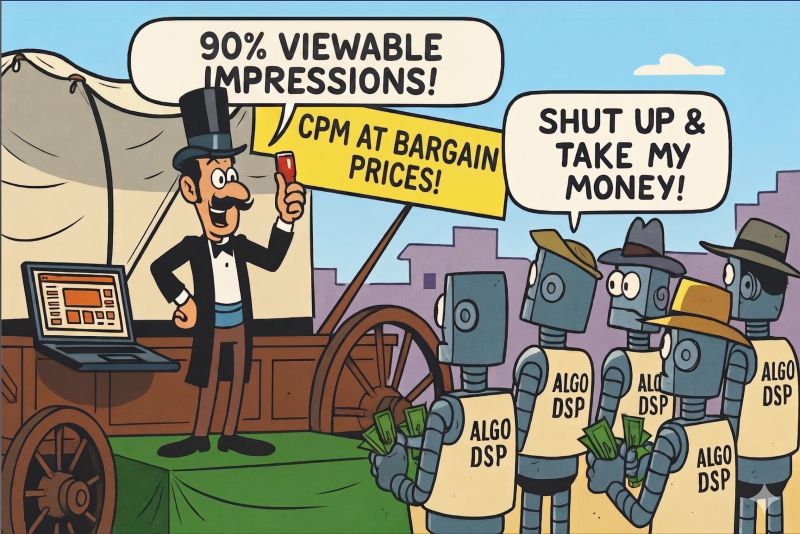
Whenever I talk to Media Traders, I ask a simple question: “Which KPIs do you use to steer your branding campaigns?” In roughly 95% of those conversations, I hear the same trio: viewability, CPM and video completion (this is my own anecdotal observation, not a representative industry survey).
These metrics are useful. But what happens when we optimize for them at the expense of actual advertising impact?
What does the MRC viewability standard actually measure?
The familiar baseline for a viewable impression is at least 50% of the ad's pixels in view for one continuous second for display, or two continuous seconds for video (with format-specific exceptions and measurement rules).
This was a major step forward. A decade ago, advertisers were rightly concerned that many impressions they purchased were never meaningfully on screen. Independent verification providers such as Integral Ad Science (IAS), DoubleVerify and Adloox helped make viewability a routine campaign-quality metric.
In the source post, I cited a 76% average viewability rate from an IAS Media Quality Report (the exact report edition, market and methodology were not specified, so this should not be interpreted as a current universal benchmark).
The blind spot: viewability is not attention
Under the baseline standard, a banner can qualify as viewable even if it occupies a tiny fraction of a large desktop monitor. Passing the threshold says something about opportunity to see—not whether a human noticed the creative or remembered the message.
That distinction matters for branding. The creative-to-screen size ratio, placement, clutter, time in view and actual user behavior can all influence the attention a campaign receives. Attention-measurement specialists such as xpln.ai seek to provide additional signals beyond traditional viewability, including models informed by panel observations (attention methodologies vary and should be evaluated independently).
We explored this distinction in our earlier article on the Open Web's attention problem.
| Metric | What it helps measure | What it cannot prove on its own |
|---|---|---|
| Viewability | Whether an impression meets a defined on-screen exposure threshold | That the user paid attention |
| CPM | Cost per thousand impressions | Quality or brand impact of those impressions |
| Video completion rate | Share of video plays completed under a given definition | That the viewer watched attentively or retained the message |
| Attention signals | Estimated or observed engagement with an ad exposure | Incremental brand lift without appropriate validation |
How optimizing a DSP for viewability can backfire
A DSP is designed to pursue the objectives and constraints set by its buyers. If the brief is simply “maximize viewability at the lowest CPM”, its buying decisions may gravitate toward placements that are easy to measure as viewable—not necessarily the placements most effective for brand storytelling.
1. Desktop inventory can look deceptively attractive
A small banner on a large desktop screen may meet the viewability threshold while commanding relatively little visual space. That does not make desktop ineffective in every context—high-impact skins, B2B audiences and other use cases can be valuable—but it does mean viewability alone is an incomplete comparison.
For more detail, see our analysis of when desktop still deserves a place in programmatic campaigns.
2. Small formats can pass the threshold without commanding attention
Formats such as 320×50 and 728×90 can be technically viewable even when their message has limited prominence. This does not mean every small format is ineffective; creative design, placement and context still matter.
3. MFA websites can exploit the KPI
Made-for-Advertising (MFA) websites may use dense layouts and sticky placements to generate inexpensive, highly viewable impressions. A campaign optimized on CPM and viewability alone risks favoring some of these environments even when their clutter undermines user experience and brand effectiveness.
We examined the mechanisms and detection challenges in why MFA websites threaten the quality Open Web.
A better approach: optimize for quality and effectiveness, not a single KPI
So should we stop measuring viewability? Absolutely not. It remains a useful guardrail. The mistake is turning a minimum exposure standard into the ultimate measure of branding performance.
- Keep viewability as a quality threshold. Use it to eliminate clearly unsuitable inventory, not to rank every impression by itself.
- Assess the creative's real prominence. Consider format size relative to the screen, placement, clutter and time in view.
- Exclude low-quality supply. Use MFA controls, brand-safety checks and transparent supply paths.
- Test attention metrics carefully. Understand how each provider models or measures attention, and validate against campaign outcomes where possible.
- Connect optimization to brand objectives. When budgets permit, use brand-lift studies, attention experiments or other outcome-based measurements to test whether KPI improvements translate into impact.
A campaign reporting 90% viewability at a very low CPM may look excellent in a dashboard. But without evidence of attention or business outcomes, it would be premature to declare it a branding success—or a failure.
Viewability is the starting line, not the finish line
Here in France, we believe advertisers deserve more than impressive-looking delivery metrics. The quality Open Web can deliver effective campaigns, but it needs smarter buying criteria and cleaner inventory.
At GreyFox Ads, we may be the smallest ad network in France, but not the least competent. Our Master Deals bring together clean supply, smart targeting, simplicity and transparent costs for Media Traders looking to activate quality French video and display inventory.
Want more effective programmatic branding in France?
Challenge your media plan with curated, quality-first French Open Web inventory and transparent campaign delivery.
Contact GreyFox AdsExplore the Master Deal