Why the Race to Lower CPMs Is Hurting the Open Web
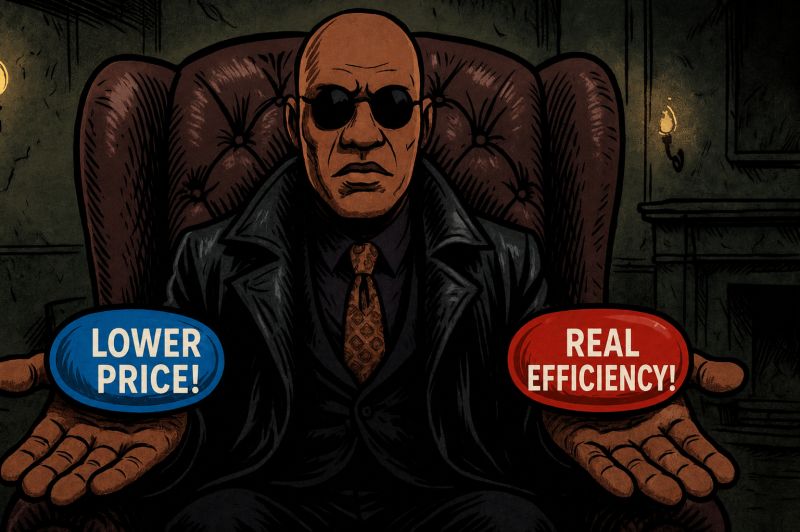
“My advertiser refuses to buy video above a €6 CPM.” A media trader told me this recently. And it raises a rather uncomfortable question: when did the price of an impression become a substitute for its actual value?
1. The €6 CPM dilemma: when price becomes the strategy
For years, branding campaigns have faced increasing pressure to deliver lower and lower CPMs. In principle, controlling media costs is perfectly reasonable. The problem begins when an advertiser believes that brand safety, viewability and video completion are already guaranteed—and therefore sees CPM as the only meaningful variable left to optimise.
Premium publishers, meanwhile, have real editorial, technical and commercial costs. They cannot always match the lowest prices offered elsewhere without changing their economics. This gap creates an opportunity for less scrupulous supply-chain actors, including certain made-for-advertising (MFA) websites and reselling arrangements.
(A €6 CPM is the threshold mentioned in the original conversation, not a universal benchmark for French video advertising.)
2. Enter the Programmatrix: when dashboards create an illusion
Imagine a campaign that looks almost perfect: low CPM, high measured viewability, impressive CTR and apparently safe websites. Yet the underlying ad experience is disappointing. Welcome to what I call the Programmatrix—a world where the metrics can look better than the actual advertising exposure.
The trick is not necessarily to falsify the numbers. It is often to optimise the conditions under which those numbers are generated.
3. Illusion #1: a brand-safe domain does not guarantee a safe placement
Domain-level checks are useful, but they can miss differences between sections, pages or subdomains. A historically reputable domain may host content or advertising environments that do not meet an advertiser’s standards. A brand-safe classification at one level should not be interpreted as a guarantee for every impression.
For buyers, the practical question is not only “Which domain did we buy?” but also “Which page, subdomain, seller and placement actually carried the ad?” (The available detail depends on the DSP, SSP, measurement vendor and privacy constraints.)
Our earlier analysis of the trade-off between brand safety and media efficiency explores why simple exclusion lists are not enough on their own.
4. Illusion #2: impressive KPIs can hide weak advertising experiences
A measured 80%+ MRC viewability rate may look fantastic. But a small sticky player or a creative occupying very little screen space can sometimes satisfy a technical viewability threshold while generating limited attention. Likewise, a very high CTR can reflect accidental taps on intrusive mobile formats rather than genuine interest.
| Dashboard signal | What it tells you | What it may miss |
|---|---|---|
| Low CPM | Low price per thousand delivered impressions | Actual exposure, attention and supply-chain quality |
| High MRC viewability | Impressions meeting a defined measurement threshold | Screen share, ad clutter and sustained attention |
| High CTR | Recorded clicks relative to impressions | Accidental taps and post-click engagement |
| High video completion rate | Videos reported as completed | Whether users watched, heard or noticed the creative |
That is why I keep arguing that viewability should not be confused with advertising effectiveness. The quality of the integration matters, and attention deserves a seat at the optimisation table.
5. Illusion #3: compensating for low prices with more ad volume
If each impression brings in very little revenue, some publishers try to compensate by generating more impressions per visit. The result can be pages crowded with advertising slots, aggressive ad refresh and multiple supply paths competing to sell the same opportunity.
For an advertiser, this can create abundant, cheap bid requests without an equivalent increase in valuable human attention. It is one reason why MFA inventory is such a difficult challenge for the Open Web.
Sending the same opportunity through several intermediaries can also multiply auction traffic. This is distinct from creating new page views, and it does not automatically mean fraud; the issue is whether the added paths contribute genuine value. We examined that question in our article on resellers and supply-path optimisation.
6. Why the warning signs are hard to spot in a DSP
Media traders do not always have all the reporting dimensions they need. Depending on the platform and integration, details such as subdomains, seller names and placement IDs may be unavailable, aggregated or accessible only through additional reporting methods.
That makes it harder to distinguish a genuinely efficient placement from one whose apparent performance is driven by aggressive implementation choices. Our practical guide to placement-level optimisation explains how to reconstruct a useful proxy when exact placement IDs are not available.
7. How to escape the Programmatrix: a buyer's checklist
| Action | What to verify |
|---|---|
| Audit the supply path | SSP, seller identity, DIRECT/RESELLER status and unnecessary intermediaries |
| Inspect the actual placement | Format size, screen share, sticky behaviour, ad density and refresh rules |
| Look beyond basic KPIs | Attention, meaningful site visits, engagement and business outcomes where measurable |
| Control MFA exposure | Publisher quality, ad-to-content balance and suspicious traffic patterns |
| Compare like with like | Device, format, audience, placement and measurement methodology before comparing CPMs |
| Test incrementality | Whether the campaign produces outcomes beyond what would have happened anyway |
None of these checks implies that expensive inventory is automatically better. The aim is to identify which impressions are worth paying for, not simply to make the average CPM rise.
8. The Open Web needs a value conversation, not a price war
Here in France, premium publishers invest in journalism, content, technology and audience relationships. If programmatic buying rewards only the cheapest reported impression, those investments become harder to sustain—while low-value supply can appear surprisingly competitive.
At GreyFox Ads, we advocate a different approach: quality French Open Web inventory, careful supply-path selection, attention to real ad exposure and transparent costs. Our Master Deal is designed to make that approach easier for media traders, including teams buying the French market from abroad.
Cheap media is not necessarily efficient media. And expensive media is not necessarily good media. The real question is: what did the advertiser actually get for the money?
Buy quality French Open Web inventory, not just a low CPM
Need clearer supply paths, stronger quality controls and transparent fees for your French programmatic campaigns? Let's talk about a curated approach.
Explore the Master DealContact GreyFox Ads