The AI Revolution That Could Reshape the Video Industry 💥
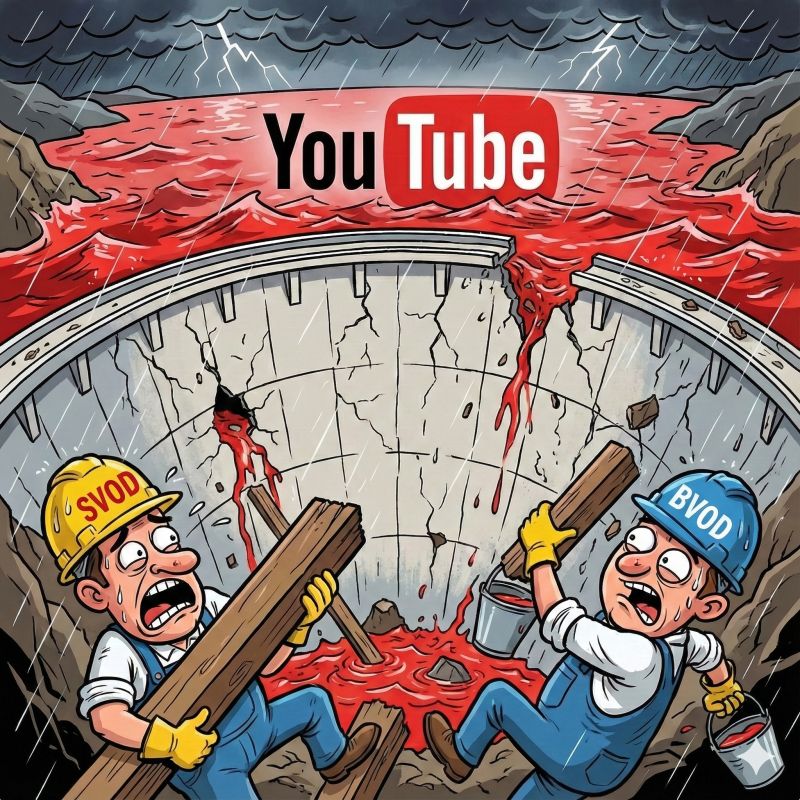
What if the next video revolution doesn't come from a Hollywood studio, a broadcaster or a streaming giant—but from millions of creators armed with generative AI?
1. A trip back to 2001: the Wikipedia lesson 🛸
To understand what could happen to video, let's go back to the early 2000s. Established encyclopedias—including France's Encyclopaedia Universalis—had built their reputations on carefully edited, professionally produced knowledge. Access to that knowledge often came with a price tag.
Then, in 2001, an unexpected newcomer arrived: Wikipedia. Free, open and collaborative. Traditional media were skeptical. “You can read absolutely anything on Wikipedia!” was a familiar criticism.
Yet volunteers contributed on an extraordinary scale. Millions of articles appeared across languages, internal links connected topics, and Wikipedia became prominent in search results around the world.
Established encyclopedias had to rethink their business models. By 2025, Wikipedia was among the world's most visited websites. The lesson? Give passionate people powerful, accessible tools, and they can build something extraordinary.
2. YouTube democratized distribution—but not production 🎥
YouTube helped establish another radically accessible model: almost anyone could publish a video on almost any subject, and viewers could access a huge range of content for free, supported largely by advertising.
It became one of the world's largest destinations for video and a major competitor for viewers' attention. Here in France, research from Arcom has highlighted the importance of online video in viewing habits (the share depends on the age group, format and measurement period).
But one major barrier remains: creating the video itself. Writing, shooting, editing, visual effects and sound design demand time, expertise and often a substantial budget—particularly for ambitious long-form storytelling.
3. Could generative AI remove the biggest barrier? 🤖
Prompt-to-video and AI-assisted production tools are lowering the cost of experimentation. Creators can generate footage, test visual styles, prototype scenes, create effects and accelerate editing without mastering every traditional production technique.
If these tools become sufficiently reliable and affordable for longer stories, many more passionate creators could produce content that previously felt out of reach. And where might they publish it? YouTube is an obvious candidate, given its audience, discovery systems and monetization infrastructure.
There is an important distinction, however: producing an impressive ten-second clip is not the same as producing a coherent 90-minute film. Character consistency, narrative quality, rights clearance, production cost and audience trust remain significant challenges.
| Production challenge | What AI could change | What still matters |
|---|---|---|
| Visual production | Generate or prototype footage faster | Consistency, quality and art direction |
| Editing and effects | Automate repetitive workflows | Creative judgment and storytelling |
| Creator budgets | Lower some production costs | Compute costs, licensing and revisions |
| Long-form content | Make ambitious projects more accessible | Plot, pacing, character continuity and rights |
4. What could this mean for SVOD and BVOD?
SVOD (subscription video on demand) platforms could face even fiercer competition for viewing time if high-quality creator-made content expands rapidly. Exclusive intellectual property, familiar franchises and professional production capabilities may become more—not less—valuable in a crowded market.
Amazon's acquisition of MGM illustrates how important recognizable entertainment libraries and established franchises can be to a streaming strategy (it is not evidence that the acquisition was a response to generative AI).
For BVOD (broadcaster video on demand), the question is different but just as pressing: how do broadcasters compete for attention and advertising budgets if the supply of video grows dramatically?
Partnerships, shared technology or alliances could become part of the answer in France and beyond. That's a strategic possibility—not a prediction that any particular broadcaster will follow this route.
5. What happens to programmatic video advertising?
If AI changes who can produce video and where people spend their time, it could also change the balance of video inventory, audience attention and programmatic media buying.
More content does not automatically mean more valuable impressions. Buyers will still need to distinguish genuine audience engagement from inflated inventory, intrusive players or low-quality placements. That's why our analyses of attention across the Open Web, CTV-washing and MFA inventory remain relevant.
For advertisers, the question isn't merely how many videos can be monetized? It's which environments genuinely earn viewers' attention—and at what cost? (Future supply growth and CPM effects remain uncertain.)
6. The GreyFox Ads perspective: quality before volume 🦊
At GreyFox Ads, we're a French programmatic advertising company helping agencies and media traders activate high-quality Open Web Display and Video inventory, including campaigns targeting the French market.
Our Master Curated Deal approach brings together:
- Supply Path Optimization: prioritizing direct publisher paths and intermediaries that add real value.
- MFA prevention: excluding Made-for-Advertising sites and subdomains.
- Format quality: favoring display formats and video players with meaningful screen share.
- Addressability: combining cookie-based and cookieless approaches within applicable privacy and consent requirements.
- Brand Safety: applying safeguards to reduce unsuitable environments.
- Fee transparency: making supply-chain costs easier to understand.
As AI changes the production side of the video industry, the buying side still needs disciplined measurement, transparency and a clear view of media quality. Related reading: AI-washing in programmatic advertising and the low-CPM trap.
7. The big question: who wins the next video revolution?
Wikipedia challenged the economics of encyclopedias. YouTube transformed video distribution. Generative AI could be the next force to reshape production—but how far it goes will depend on storytelling, economics, intellectual property and audience behavior.
For media traders and publishers, the question worth watching is simple: if anyone can make a video, how will we decide which video impressions are actually worth buying?
Read the original LinkedIn post.
Looking for a quality programmatic advertising partner?
Want to improve the efficiency and transparency of your Display and Video campaigns in France? Let's talk about your programmatic challenges.
Contact GreyFox Ads