The Dark Side of Header Bidding Wrappers: Power Strips and Reseller Chains 🔌
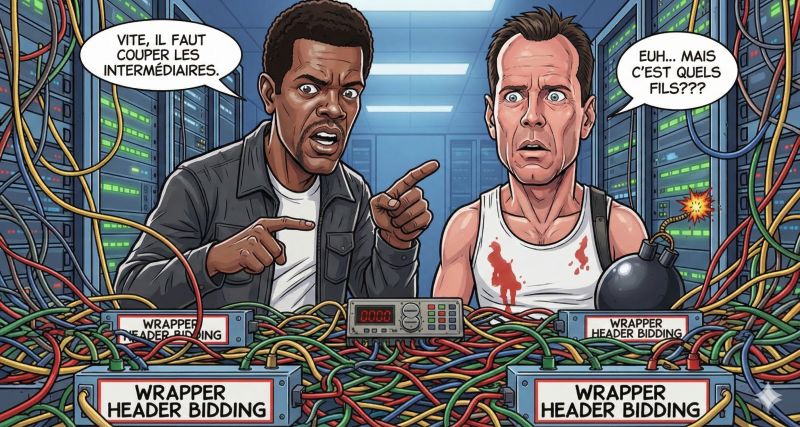
Header bidding helped publishers escape the old advertising waterfall. But when demand connections multiply, the supply chain can start looking like a power strip plugged into another power strip. 🔌🔌😈
1. From the programmatic waterfall to header bidding
About a decade ago, publishers often monetized impressions through a waterfall: demand sources were called in sequence. In common Google Ad Manager setups, Google's exchange enjoyed an advantageous position while other SSPs could be considered later in the chain (the exact priority depended on the configuration).
Not exactly a level playing field…
Around 2015, header bidding wrappers helped change the game. Think of a wrapper as a power strip: instead of plugging in one SSP at a time, a publisher could connect several demand partners and invite them to compete for the same impression. More competition could mean better yield and a clearer view of bidding dynamics. 🥇
2. What is client-side header bidding?
Early widely adopted implementations, including Prebid.js, ran auctions from the visitor's browser. Multiple SSPs could receive requests in parallel, rather than waiting for a sequential waterfall.
- 👀 Visibility: browser-based auction activity and some bids can be inspected with developer tools.
- ⏩ Parallelism: several demand partners can be called during the same auction window.
- ⌛ The catch: additional adapters and requests may increase browser processing, network activity and page latency.
So publishers needed to be selective about which partners they plugged in. More demand connections are useful only if they generate incremental value without damaging the user experience.
3. What changed with server-side header bidding?
Then came server-side auction infrastructure and server-to-server demand integrations. Examples include Prebid Server, Google Open Bidding and Amazon Publisher Services Transparent Ad Marketplace (TAM) (these solutions have different technical architectures and commercial models).
Instead of the browser calling every partner directly, a server coordinates much of the auction activity. That can reduce browser-side overhead and make it easier to manage more connections.
But the trade-offs matter: the publisher may have less direct visibility into every step, and additional network hops, identity availability and server processing can affect results. Server-side does not mean zero latency, unlimited partners or guaranteed higher yield.
4. Client-side vs server-side header bidding: what is the difference?
| Dimension | Client-side | Server-side |
|---|---|---|
| Where calls are coordinated | Visitor's browser | Server-side infrastructure |
| Browser workload | Can grow with adapters and partners | Often lower, though not eliminated |
| Auction visibility | Some browser activity is directly inspectable | Often relies more on platform logs and reporting |
| Latency | Browser and network overhead | Server processing and network hops still matter |
| Commercial outcome | Depends on implementation, demand quality, consent, identity and auction settings | |
Neither architecture is inherently superior in every situation. A publisher needs to test the real incremental revenue and operational cost of each partner (rather than treating the number of connections as a performance KPI).
5. Why can header bidding lead to complex reseller chains?
Imagine a publisher adding a reseller's demand connection. That reseller works with other intermediaries, which may aggregate still more sources. Suddenly, the supply chain starts looking like a power strip plugged into another power strip. 🔌🔌😵💫
One visible symptom can be a very long ads.txt file containing many authorized sellers. But an entry in ads.txt is an authorization record—not proof that a particular impression traveled through that seller, or that every listed connection is active at once.
For more context, read our guide to ads.txt in programmatic advertising and our analysis of reseller-heavy bid-request supply.
6. What are the risks for advertisers?
Every unnecessary intermediary can introduce extra fees, operational complexity and reduced visibility into the actual route an impression takes. 💸
That does not mean every reseller is bad. Some offer genuine incremental demand, technical capabilities or access to inventory that buyers would otherwise struggle to reach. The right question is: what value does this intermediary add?
For programmatic buyers, practical checks include identifying the seller relationship, comparing duplicate supply paths, examining auction and transaction signals where available, and understanding the cost chain (the available evidence depends on SSP, DSP and contractual access).
These issues are central to financial transparency in programmatic advertising and to our discussion of transaction IDs.
7. How GreyFox Ads approaches Supply Path Optimization
Here at GreyFox Ads, we're a French programmatic curation company. We believe a high-quality Open Web should offer genuine efficiency for advertisers—not a competition to see who can build the longest chain of intermediaries.
Our Master Curated Deal prioritizes SSP seats operated directly by publishers, while retaining resellers that provide demonstrable added value. Unnecessary supply paths? We filter them out. 🚫
- 📡 SPO: direct publisher supply and value-adding resellers
- 🚫 MFA prevention: filtering Made-for-Advertising sites and subdomains
- 🛡️ Brand safety: reducing exposure to unsuitable environments
- 📐 Screen share: favoring formats that occupy a meaningful portion of the screen
- 🎯 Addressability: cookie-based and cookieless approaches, including consentless environments only where legally and technically permitted
- 🪟 Fee transparency: making the programmatic cost chain easier to understand
It's also why we examine the wider supply-quality problem, including MFA websites.
8. The key takeaway: more plugs do not guarantee better advertising
Header bidding made programmatic auctions more competitive. Server-side integrations made it easier to scale demand connections. But more connections do not automatically mean better outcomes.
For advertisers, the goal is not the longest possible chain of intermediaries. It is to buy quality inventory through efficient, transparent supply paths. That's the real purpose of SPO.
Original LinkedIn post: Read the original post on LinkedIn.
Looking for a quality-focused programmatic advertising partner?
Want cleaner supply paths and more effective Display and Video campaigns in France? Let's talk.
Contact GreyFox AdsDiscover the Master Deal